
Cover
Vol 2 Issue 9 October 95 UK £1.95 US $4.95
generator
The energy and culture of dance music
DJ Crystl
Photek
Phil Asher
Randall
µ-Ziq
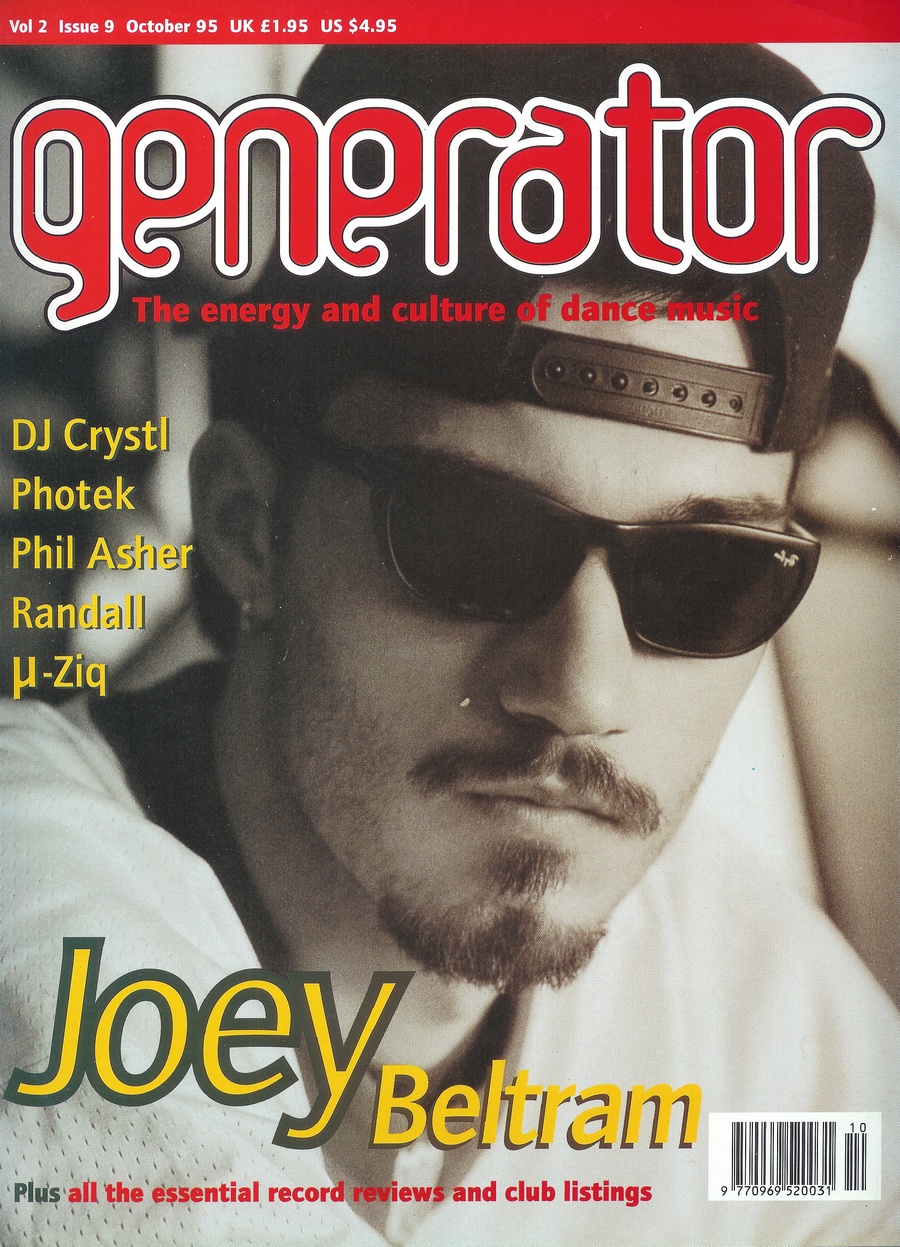
Joey Beltram
Plus all the essential record reviews and club listings
Page 3
Contents
October 1995 Vol 2 Issue 9
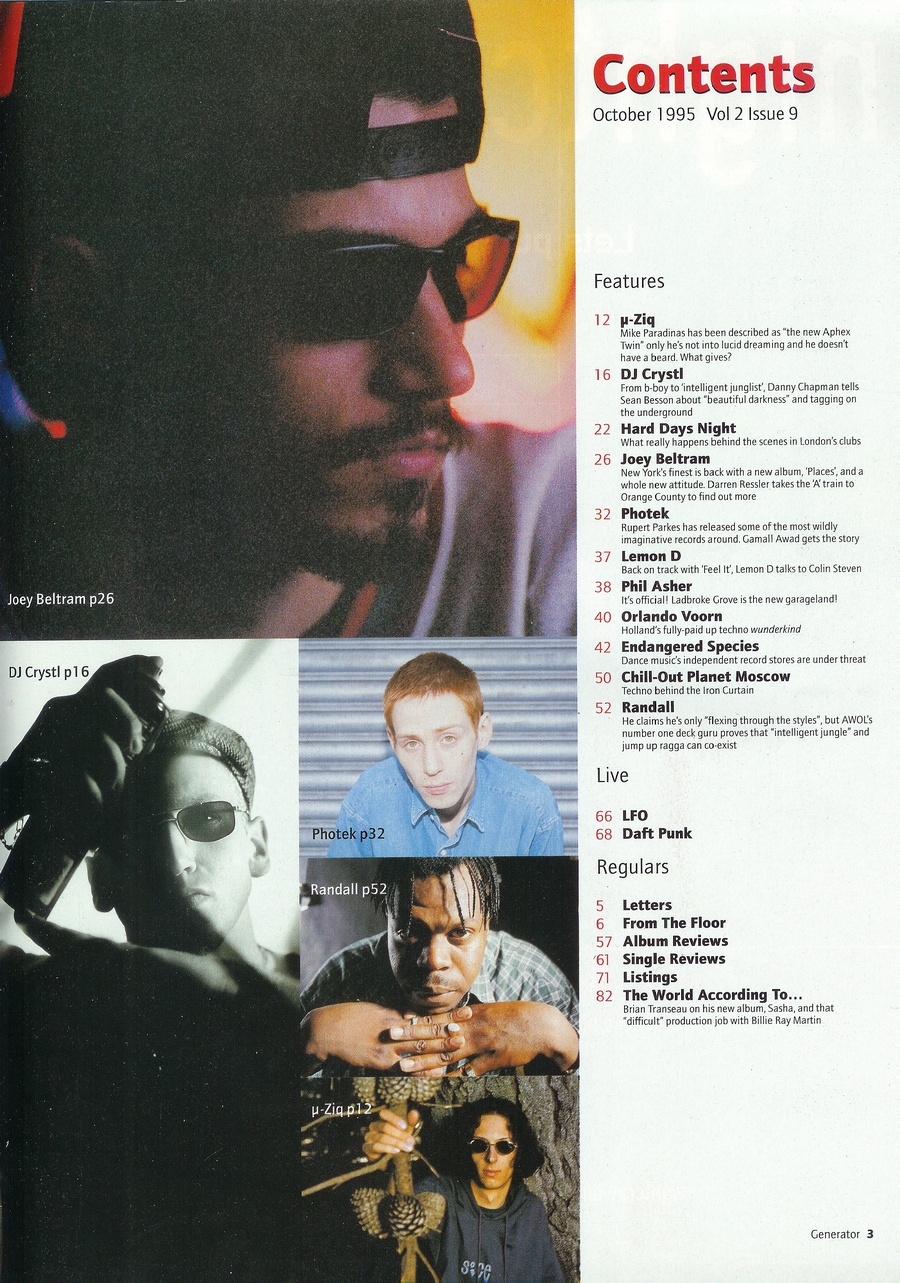
Joey Beltram p26
DJ Crystl p16
Photek p32
Randall p52
µ-Ziq p12
Features
12 µ-Ziq
Mike Paradinas has been described as "the new Aphex Twin" only he's not into lucid dreaming and he doesn't have a beard. What gives?
16 DJ Crystl
From b-boy to 'intelligent junglist', Danny Chapman tells Sean Besson about "beautiful darkness" and tagging on the underground
22 Hard Days Night
What really happens behind the scenes in London's clubs
26 Joey Beltram
New York's finest is back with a new album, 'Places', and a whole new attitude. Darren Ressler takes the 'A' train to Orange County to find out more
32 Photek
Rupert Parkes has released some of the most wildly imaginative records around. Gamall Awad gets the story
37 Lemon D
Back on track with 'Feel It', Lemon D talks to Colin Steven
38 Phil Asher
It's official! Ladbroke Grove is the new garageland!
40 Orlando Voorn
Holland's fully-paid up techno wunderkind
42 Endangered Species
Dance music's independent record stores are under threat
50 Chill-Out Planet Moscow
Techno behind the Iron Curtain
52 Randall
He claims he's only "flexing through the styles", but AWOL's number one deck guru proves that "intelligent jungle" and jump up ragga can co-exist
Live
66 LFO
68 Daft Punk
Regulars
5 Letters
6 From The Floor
57 Album Reviews
61 Single Reviews
71 Listings
82 The World According To...
Brian Transeau on his new album, Sasha, and that "difficult" production job with Billie Ray Martin
Generator 3
Page 12
Feature
Feature profile
12 Generator
Page 13
Interview
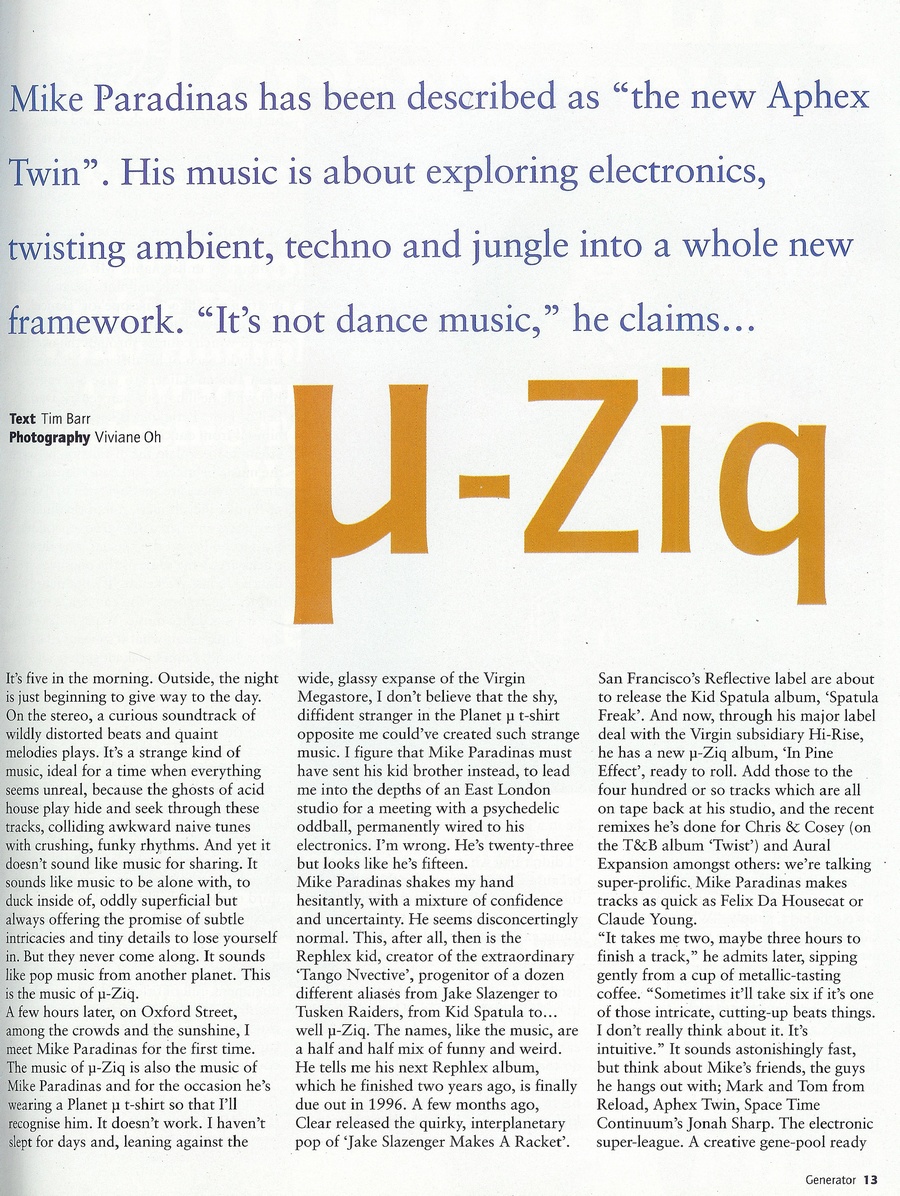
Mike Paradinas has been described as "the new Aphex Twin". His music is about exploring electronics, twisting ambient, techno and jungle into a whole new framework. "It's not dance music," he claims...
Text Tim Barr
Photography Viviane Oh
μ-Ziq
It's five in the morning. Outside, the night is just beginning to give way to the day. On the stereo, a curious soundtrack of wildly distorted beats and quaint melodies plays. It's a strange kind of music, ideal for a time when everything seems unreal, because the ghosts of acid house play hide and seek through these tracks, colliding awkward naive tunes with crushing, funky rhythms. And yet it doesn't sound like music for sharing. It sounds like music to be alone with, to duck inside of, oddly superficial but always offering the promise of subtle intricacies and tiny details to lose yourself in. But they never come along. It sounds like pop music from another planet. This is the music of μ-Ziq.
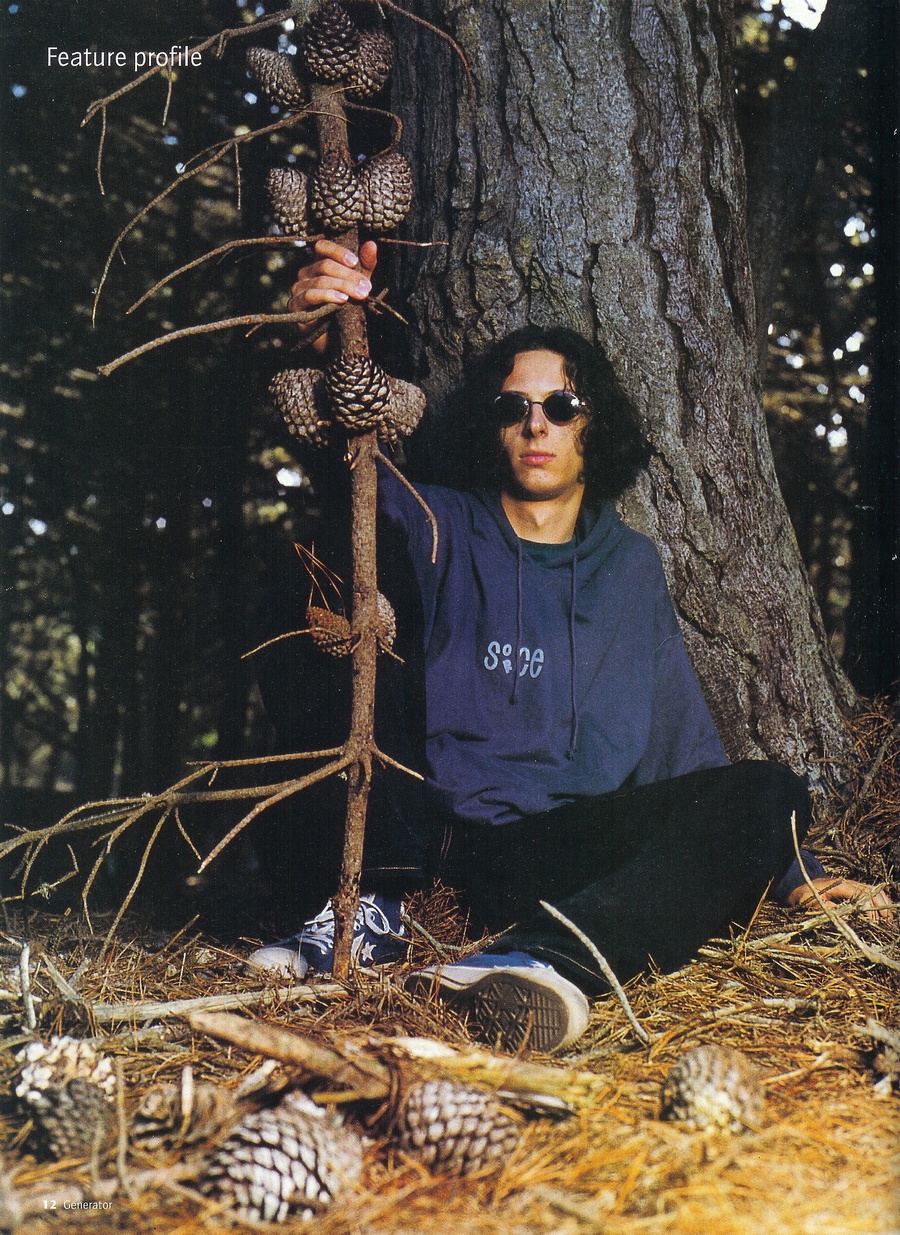
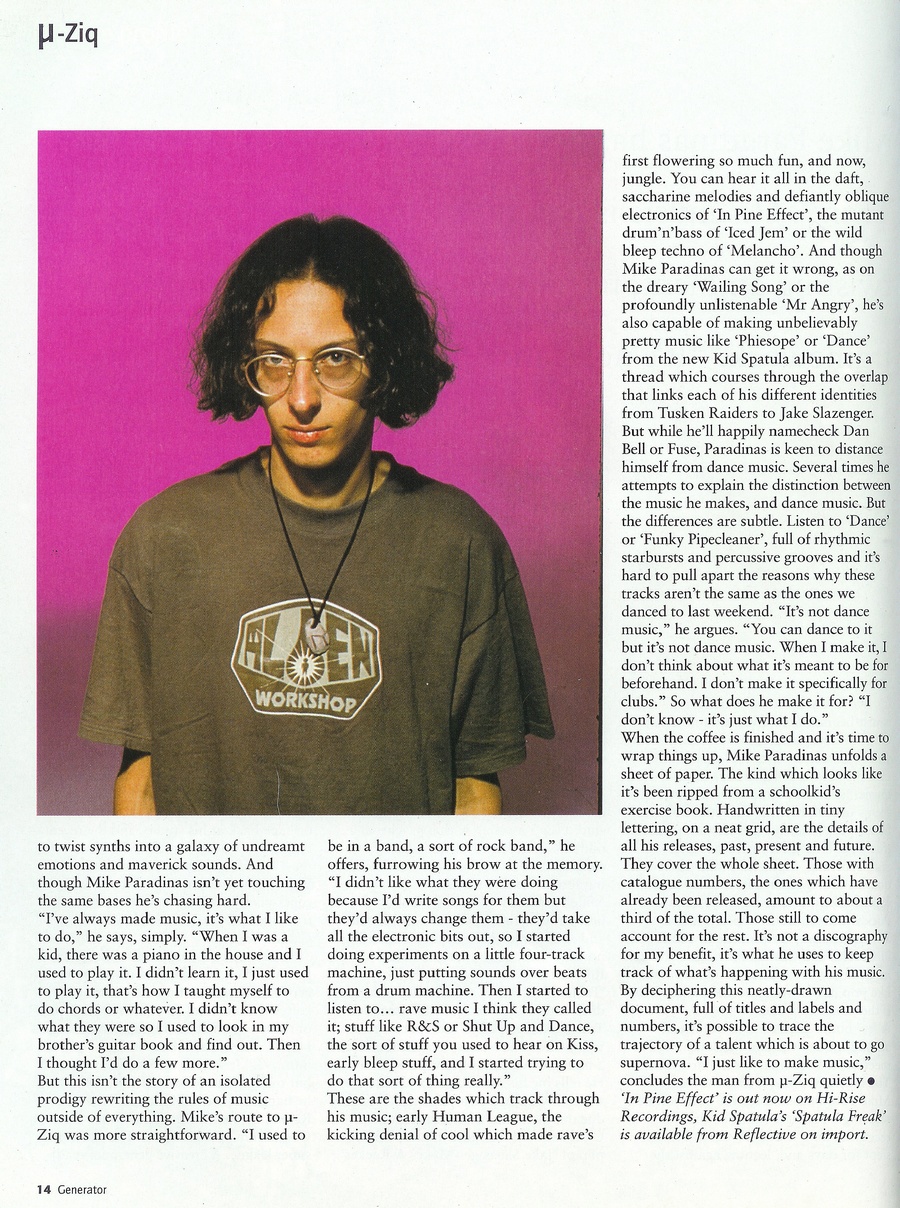
A few hours later, on Oxford Street, among the crowds and the sunshine, I meet Mike Paradinas for the first time. The music of μ-Ziq is also the music of Mike Paradinas and for the occasion he's wearing a Planet μ t-shirt so that I'll recognise him. It doesn't work. I haven't slept for days and, leaning against the wide, glassy expanse of the Virgin Megastore, I don't believe that the shy, diffident stranger in the Planet μ t-shirt opposite me could've created such strange music. I figure that Mike Paradinas must have sent his kid brother instead, to lead me into the depths of an East London studio for a meeting with a psychedelic oddball, permanently wired to his electronics. I'm wrong. He's twenty-three but looks like he's fifteen.
Mike Paradinas shakes my hand hesitantly, with a mixture of confidence and uncertainty. He seems disconcertingly normal. This, after all, then is the Rephlex kid, creator of the extraordinary 'Tango Nvective', progenitor of a dozen different aliases from Jake Slazenger to Tusken Raiders, from Kid Spatula to... well μ-Ziq. The names, like the music, are a half and half mix of funny and weird. He tells me his next Rephlex album, which he finished two years ago, is finally due out in 1996. A few months ago, Clear released the quirky, interplanetary pop of 'Jake Slazenger Makes A Racket'.
San Francisco's Reflective label are about to release the Kid Spatula album, 'Spatula Freak'. And now, through his major label deal with the Virgin subsidiary Hi-Rise, he has a new μ-Ziq album, 'In Pine Effect', ready to roll. Add those to the four hundred or so tracks which are all on tape back at his studio, and the recent remixes he's done for Chris & Cosey (on the T&B album 'Twist') and Aural Expansion amongst others: we're talking super-prolific. Mike Paradinas makes tracks as quick as Felix Da Housecat or Claude Young.
"It takes me two, maybe three hours to finish a track," he admits later, sipping gently from a cup of metallic-tasting coffee. "Sometimes it'll take six if it's one of those intricate, cutting-up beats things. I don't really think about it. It's intuitive." It sounds astonishingly fast, but think about Mike's friends, the guys he hangs out with; Mark and Tom from Reload, Aphex Twin, Space Time Continuum's Jonah Sharp. The electronic super-league. A creative gene-pool ready
Generator 13
Page 14
Interview
µ-Ziq
to twist synths into a galaxy of undreamt emotions and maverick sounds. And though Mike Paradinas isn't yet touching the same bases he's chasing hard.
"I've always made music, it's what I like to do," he says, simply. "When I was a kid, there was a piano in the house and I used to play it. I didn't learn it, I just used to play it, that's how I taught myself to do chords or whatever. I didn't know what they were so I used to look in my brother's guitar book and find out. Then I thought I'd do a few more."
But this isn't the story of an isolated prodigy rewriting the rules of music outside of everything. Mike's route to µ-Ziq was more straightforward. "I used to be in a band, a sort of rock band," he offers, furrowing his brow at the memory. "I didn't like what they were doing because I'd write songs for them but they'd always change them - they'd take all the electronic bits out, so I started doing experiments on a little four-track machine, just putting sounds over beats from a drum machine. Then I started to listen to... rave music I think they called it; stuff like R&S or Shut Up and Dance, the sort of stuff you used to hear on Kiss, early bleep stuff, and I started trying to do that sort of thing really."
These are the shades which track through his music; early Human League, the kicking denial of cool which made rave's
first flowering so much fun, and now, jungle. You can hear it all in the daft, saccharine melodies and defiantly oblique electronics of 'In Pine Effect', the mutant drum'n'bass of 'Iced Jem' or the wild bleep techno of 'Melancho'. And though Mike Paradinas can get it wrong, as on the dreary 'Wailing Song' or the profoundly unlistenable 'Mr Angry', he's also capable of making unbelievably pretty music like 'Phiesope' or 'Dance' from the new Kid Spatula album. It's a thread which courses through the overlap that links each of his different identities from Tusken Raiders to Jake Slazenger. But while he'll happily namecheck Dan Bell or Fuse, Paradinas is keen to distance himself from dance music. Several times he attempts to explain the distinction between the music he makes, and dance music. But the differences are subtle. Listen to 'Dance' or 'Funky Pipecleaner', full of rhythmic starbursts and percussive grooves and it's hard to pull apart the reasons why these tracks aren't the same as the ones we danced to last weekend. "It's not dance music," he argues. "You can dance to it but it's not dance music. When I make it, I don't think about what it's meant to be for beforehand. I don't make it specifically for clubs." So what does he make it for? "I don't know - it's just what I do."
When the coffee is finished and it's time to wrap things up, Mike Paradinas unfolds a sheet of paper. The kind which looks like it's been ripped from a schoolkid's exercise book. Handwritten in tiny lettering, on a neat grid, are the details of all his releases, past, present and future. They cover the whole sheet. Those with catalogue numbers, the ones which have already been released, amount to about a third of the total. Those still to come account for the rest. It's not a discography for my benefit, it's what he uses to keep track of what's happening with his music. By deciphering this neatly-drawn document, full of titles and labels and numbers, it's possible to trace the trajectory of a talent which is about to go supernova. "I just like to make music," concludes the man from µ-Ziq quietly ●
'In Pine Effect' is out now on Hi-Rise Recordings, Kid Spatula's 'Spatula Freak' is available from Reflective on import.
14 Generator
Page 16
Feature
Feature profile
DJ Crystl
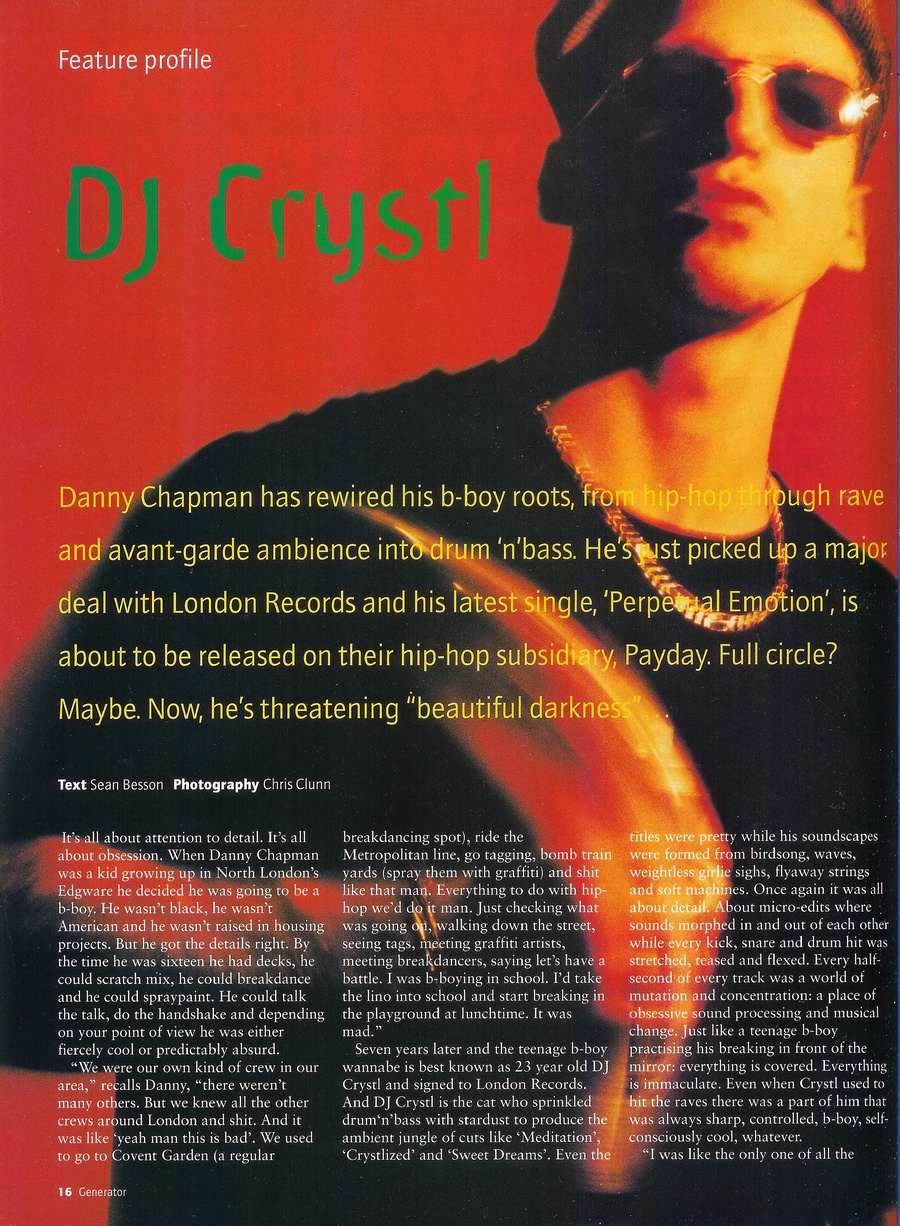
Danny Chapman has rewired his b-boy roots, from hip-hop through rave and avant-garde ambience into drum 'n'bass. He's just picked up a major deal with London Records and his latest single, 'Perpetual Emotion', is about to be released on their hip-hop subsidiary, Payday. Full circle? Maybe. Now, he's threatening "beautiful darkness"...
Text Sean Besson Photography Chris Clunn
It's all about attention to detail. It's all about obsession. When Danny Chapman was a kid growing up in North London's Edgware he decided he was going to be a b-boy. He wasn't black, he wasn't American and he wasn't raised in housing projects. But he got the details right. By the time he was sixteen he had decks, he could scratch mix, he could breakdance and he could spraypaint. He could talk the talk, do the handshake and depending on your point of view he was either fiercely cool or predictably absurd.
"We were our own kind of crew in our area," recalls Danny, "there weren't many others. But we knew all the other crews around London and shit. And it was like 'yeah man this is bad'. We used to go to Covent Garden (a regular breakdancing spot), ride the Metropolitan line, go tagging, bomb train yards (spray them with graffiti) and shit like that man. Everything to do with hip-hop we'd do it man. Just checking what was going on, walking down the street, seeing tags, meeting graffiti artists, meeting breakdancers, saying let's have a battle. I was b-boying in school. I'd take the lino into school and start breaking in the playground at lunchtime. It was mad."
Seven years later and the teenage b-boy wannabe is best known as 23 year old DJ Crystl and signed to London Records. And DJ Crystl is the cat who sprinkled drum'n'bass with stardust to produce the ambient jungle of cuts like 'Meditation', 'Crystlized' and 'Sweet Dreams'. Even the titles were pretty while his soundscapes were formed from birdsong, waves, weightless girlie sighs, flyaway strings and soft machines. Once again it was all about detail. About micro-edits where sounds morphed in and out of each other while every kick, snare and drum hit was stretched, teased and flexed. Every half-second of every track was a world of mutation and concentration: a place of obsessive sound processing and musical change. Just like a teenage b-boy practising his breaking in front of the mirror: everything is covered. Everything is immaculate. Even when Crystl used to hit the raves there was a part of him that was always sharp, controlled, b-boy, self-consciously cool, whatever.
"I was like the only one of all the
16 Generator
Page 17
Interview
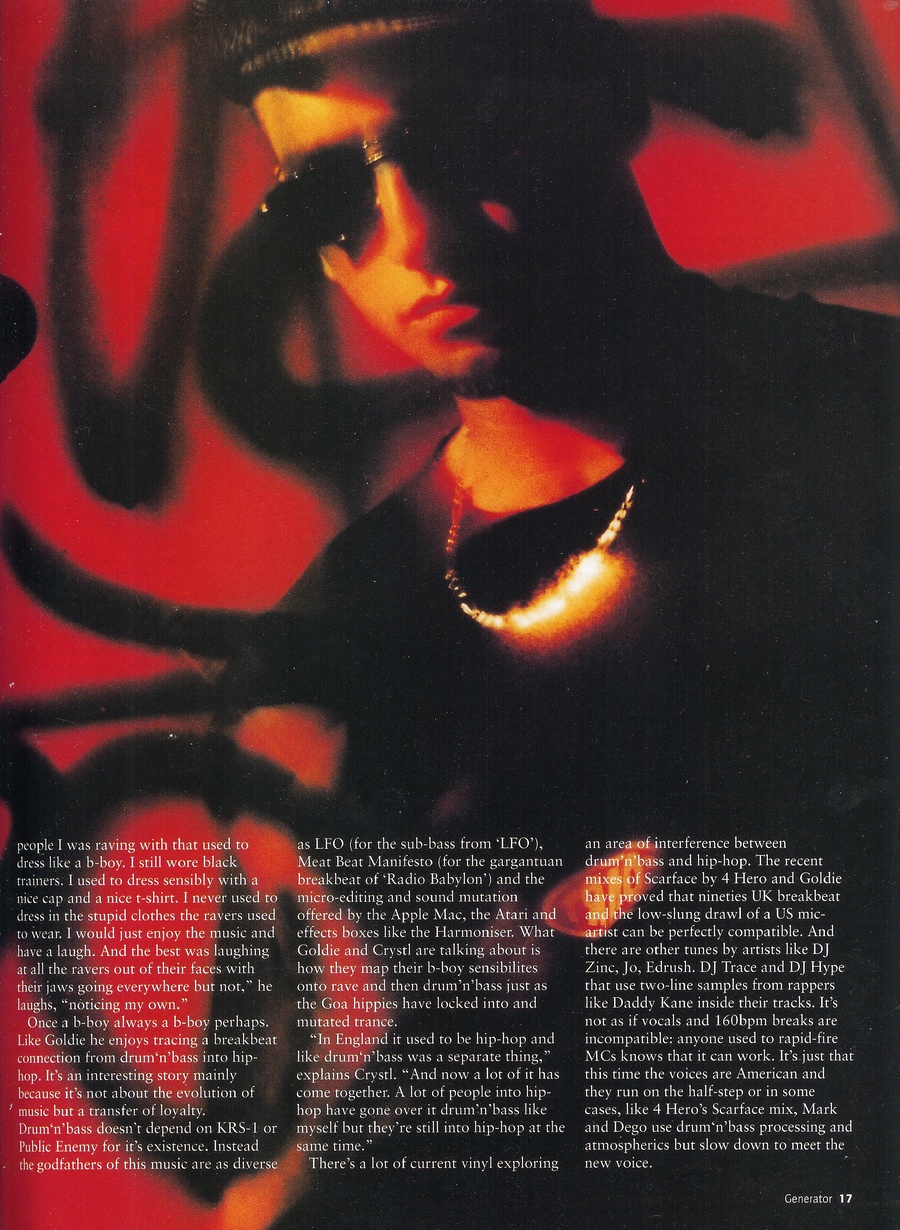
people I was raving with that used to dress like a b-boy. I still wore black trainers. I used to dress sensibly with a nice cap and a nice t-shirt. I never used to dress in the stupid clothes the ravers used to wear. I would just enjoy the music and have a laugh. And the best was laughing at all the ravers out of their faces with their jaws going everywhere but not," he laughs, "noticing my own."
Once a b-boy always a b-boy perhaps. Like Goldie he enjoys tracing a breakbeat connection from drum'n'bass into hip-hop. It's an interesting story mainly because it's not about the evolution of music but a transfer of loyalty. Drum'n'bass doesn't depend on KRS-1 or Public Enemy for it's existence. Instead the godfathers of this music are as diverse as LFO (for the sub-bass from 'LFO'), Meat Beat Manifesto (for the gargantuan breakbeat of 'Radio Babylon') and the micro-editing and sound mutation offered by the Apple Mac, the Atari and effects boxes like the Harmoniser. What Goldie and Crystl are talking about is how they map their b-boy sensibilites onto rave and then drum'n'bass just as the Goa hippies have locked into and mutated trance.
"In England it used to be hip-hop and like drum'n'bass was a separate thing," explains Crystl. "And now a lot of it has come together. A lot of people into hip-hop have gone over it drum'n'bass like myself but they're still into hip-hop at the same time."
There's a lot of current vinyl exploring an area of interference between drum'n'bass and hip-hop. The recent mixes of Scarface by 4 Hero and Goldie have proved that nineties UK breakbeat and the low-slung drawl of a US mic-artist can be perfectly compatible. And there are other tunes by artists like DJ Zinc, Jo, Edrush. DJ Trace and DJ Hype that use two-line samples from rappers like Daddy Kane inside their tracks. It's not as if vocals and 160bpm breaks are incompatible: anyone used to rapid-fire MCs knows that it can work. It's just that this time the voices are American and they run on the half-step or in some cases, like 4 Hero's Scarface mix, Mark and Dego use drum'n'bass processing and atmospherics but slow down to meet the new voice.
Generator 17
Page 18
Interview
DJ Crystl
"People have been sampling rap and using it on drum'n'bass tracks," confirms Crystl, "but I thought it would be good to get a whole verse done and build up a track around it. So we did it."
Crystl worked with Headrush, two Harlem rappers signed to Mo'Wax and went into the studio with UK rapper Shylock from The Brotherhood to cut hip-hop mixes. Then he went back on his own to sort out the drum'n'bass. The result is his new single 'Perptual Emotion' and by a sly piece of sleight of hand is going to be released on Payday, a London Records affiliated hip-hop label best known for artists like Showbiz and AG. The tracks are interesting, bitching and tripping. Like you'd expect it's somewhere between Tricky and 4 Hero: stripped down atmospherics that shift between alien sci-fi and stoned urban jazz while Headrush drawl and roll. Their rhymes deal with a lot of things but they keep talking abut New York City and how rough it is over there. It's tempting to ask Crystl why he didn't work with UK rappers and build a track that deals with English experiences rather than sounds.
"I love American rap basically," smiles Crystl.
It's kind of weird to listen to because it connects. Sure the voices, the language and the experiences are as US as McDonalds but the snares, effects and drones are pure drum'n'bass and pure UK. But it's also kind of weird when Headrush start to use the word 'nigger' on a record that's going to be credited to DJ Crystl, a white producer. Is this an issue for Crystl?
"Not really because it isn't a white person rapping so I don't give a shit really. They're like American and they call themselves that. They're all brothers, they say 'what's up nigger' and that's what they say. Obviously I don't call any black people that. I don't go up to black people and say 'what's up nigger'. I'd get my fucking head shot off. If people don't understand it, they're not into hip-hop."
And of course Crystl's always been into his hip-hop. For a while it even prevented him from getting into the rave. Like a lot of b-boys and other posses like the acid jazz set, he almost got stuck in a cultural dead-end.
"I was so into hip-hop that I used to diss acid," recalls DJ Crystl. "I hated it. We used to drive around and laugh at people in flares and shit. Just pointing and going 'Yeah you acid freaks man'. I suppose they were doing that to the hip-hop heads, taking the piss out of us. Fair enough."
And then Crystl started raving. Like most people he didn't really know what was going on but a few friends, the sort who get almost messianic about the whole thing, made an effort to take him out and turn him onto the scene.
"A group of my friends who weren't really into hip-hop that much managed to get into raving, did E's and everything and as you can guess I got drawn into going. They pulled me to a club and I hated it. I absolutely hated it. I was very suspicious about whether to do E or not. I was like standing next to the speakers going like 'fucking shut up'. The music was doing my head in, everybody was dancing around, treading on my feet and I just got paranoid and claustrophobic. So I went home and put on some hip-hop and felt good."
But he went out again and eventually he started to enjoy it. "I went to Telepathy and Rage," smiles Danny, "and to me that's what did it. I was standing in this club and I started coming up on this E and I heard the maddest, dirtiest drum'n'bass. And it was just like what it did for me, I couldn't believe what I was hearing. I got a wicked buzz and I went another week and another week and it progressed from there."
At the time Crystl was somewhere in between studying graphics at college and working for a design company. He was also the dj for rap outfit The Brotherhood: working live and in the studio on scratches, sounds and beats. And of course the more he partied the more he fucked up his work with The Brotherhood.
"We had an interview on Kiss FM and I didn't want to go because I'd been raving the night before. I was still coming off this E and I was out of my box and I had to take this mixer in the studio and cut some beats up. And I was just sleeping, I couldn't be bothered. It was like 'Quick get me out of here. Let me get to a rave man'. I ended up dissing my own background for a minute. Thinking about it, I must've been mad..."
It was kind of inevitable really.
"I went to Telepathy and Rage... and to me that's what did it. I was standing in this club and I started coming up on this E and I heard the maddest, dirtiest drum'n'bass... I couldn't believe what I was hearing. I got a wicked buzz and I went another week and another week and it progressed from there."
18 Generator
Page 20
Interview
DJ Crystyl
Sometimes house, techno or rave feels like another reality: a form of VR that can only be accessed through taking E. And once you're in there, locked deep, everything else seems so far away. It's like you're becoming a different person. And then you have to decide, especially if you're an artist, what happens next? How much of your old self can you incorporate into the new.
"I used to listen to mix tapes," recalls Crystl. "Micky Finn, Grooverider. I could see the hip-hop element there which is why I liked it as well. I liked the breakbeats and then I heard a couple of hip-hop tracks which I already knew sampled in there. But for a whole year I wasn't really listening to much hip-hop. In fact, I hated it and couldn't relate to it. The ecstasy had turned my brain around and fused me onto the rave. I couldn't relate to the 90bpm speed and rap of hip-hop. It took me a long time to get back into it. It was only when I started getting off the drugs and the E's that I started getting back into hip-hop again because my mind was free and I had nothing to block it. I carried on raving but then I was listening to hip-hop as well."
Err... how much ecstasy were you taking Crystl?
"The most I'd do was a couple. I'm very hyperactive. I used to get fucked on a quarter."
A born again b-boy with a head like a raver and a lifetime of cool, control and wearing the right clothes. It's an interesting combination. And then he lost his job. He was already out of The Brotherhood and then the graphics company he was working for went out of business.
"I believe that was fate basically," enthuses Crystl. "I was out of work for three years doing fuck all. Just bumming about, going on the trains, bombing and doing a bit of graf here and there, which I still do now. And then a mate of mine, Sasha, started a record label, DJ Recordings, and I did the first track for it."
The cut was 'Drop Extasy' hammering a Yes (early seventies UK rock band) and 'Drop the Bass' sample with the same kind of fury that Doc Scott brought to his 'Here Come The Drums' release. From
then on Crystl was a producer, working with technician/engineer Pete Parsons and tracing drum'n'bass' arc from early darkcore to liquid ambience and the current hip-hop interface. Talking to him now and what's really cool is that he doesn't condemn or diss any of the music he's passed through. Crystl still likes hip-hop, he still likes ambient and he still likes dark Belgian tracks like 'Anastasia' or 'Mentasm'. Although he now finds that sort of intense head-wrecking nastiness in the Wu-Tun Clan instead.
"I like dark, spooky tracks that send shivers up my spine," leers Crystl. "I like nasty evil twisted shit. I love it. It makes me feel good man but I also like the ambient stuff. The stuff you can just relax to and close your eyes. And I also like the stuff that makes you want to out a knife and slice someone's neck open."
He just flickers back and forth: like when tearing breaks rip his ambience to shreds or like the variety he's promising for his major label debut album early next year.
"There isn't a name for it yet. There isn't even a name for the style that I'm doing. It's just gonna be weird. There's
gonna be some slow tracks on there, some female vocals, I'm not even classifying it as drum'n'bass. It's just gonna be interesting. Just wait. It's gonna be drum'n'bass speed but I'm not calling it drum'n'bass. It's gonna be a bit of everything put together."
Maybe this is the final thing Crystl's taken from his b-boy life: the ability to speak in rants, to let your words flow like rhymes and let the speed and bravado take over.
"There will be stuff on the album that's ambient and really beautiful. But not pretty, more like beautifully dark. Not ambient as in 'Oh let's rush off our boxes' but with a hard edge to it. It's gonna be beautiful and all of a sudden it'll change and be seriously dirty. It'll fucking tear your eyeballs out man."
Scary shit huh? Where do you live man?
"I'm still living at home."
The same bedroom you grew up in?
"Yeah a nice big bedroom. I actually get on really well with my parents. They're really down with what I'm doing. At the moment I'm cool, just chilling. We've got a nice relationship going."
Cool
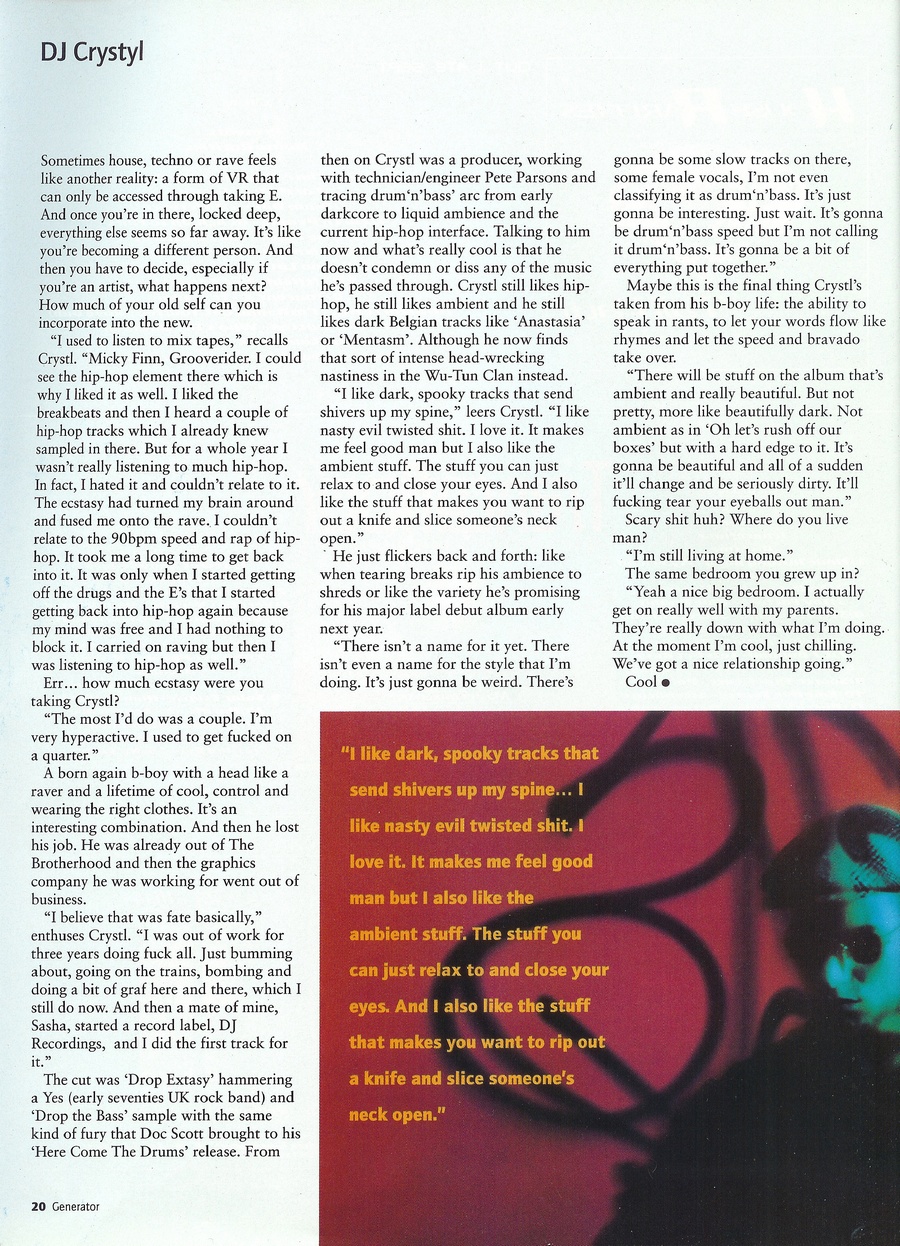
"I like dark, spooky tracks that send shivers up my spine... I like nasty evil twisted shit. I love it. It makes me feel good man but I also like the ambient stuff. The stuff you can just relax to and close your eyes. And I also like the stuff that makes you want to rip out a knife and slice someone's neck open."
20 Generator
Page 26
Feature
Feature profile
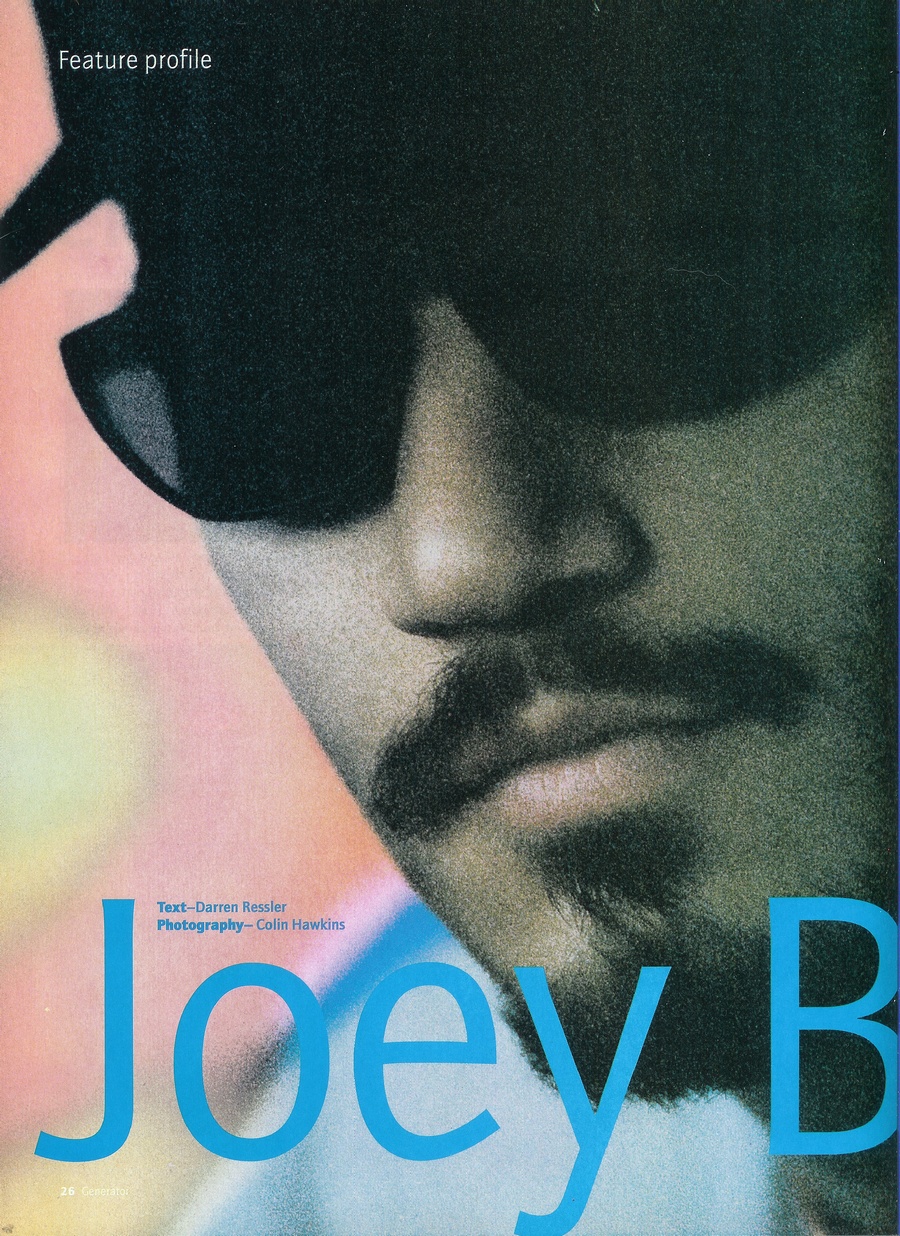
Text—Darren Ressler
Photography— Colin Hawkins
Joey B
26 Generator
Page 27
Interview
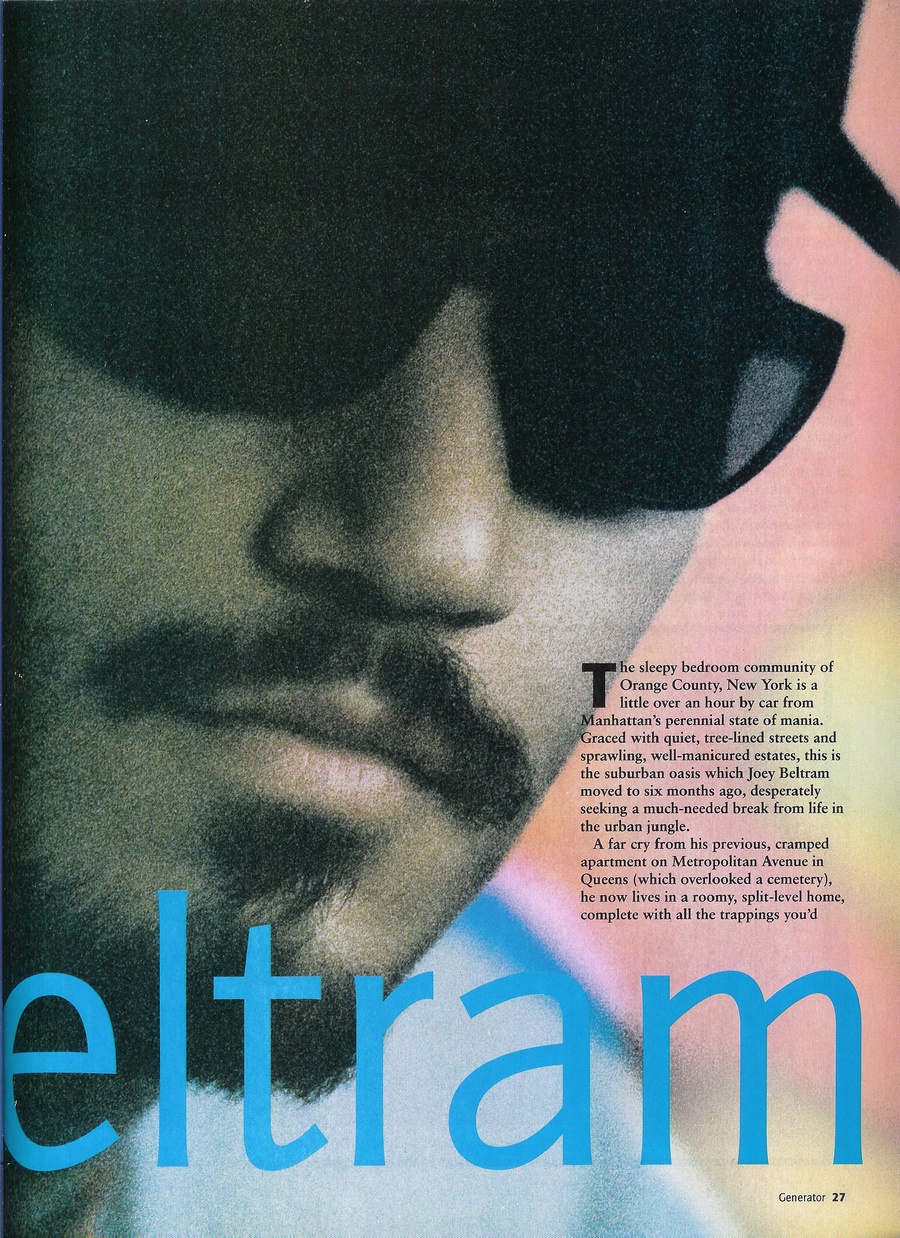
The sleepy bedroom community of Orange County, New York is a little over an hour by car from Manhattan's perennial state of mania. Graced with quiet, tree-lined streets and sprawling, well-manicured estates, this is the suburban oasis which Joey Beltram moved to six months ago, desperately seeking a much-needed break from life in the urban jungle.
A far cry from his previous, cramped apartment on Metropolitan Avenue in Queens (which overlooked a cemetery), he now lives in a roomy, split-level home, complete with all the trappings you'd
Generator 27
Page 12
Feature
Feature profile
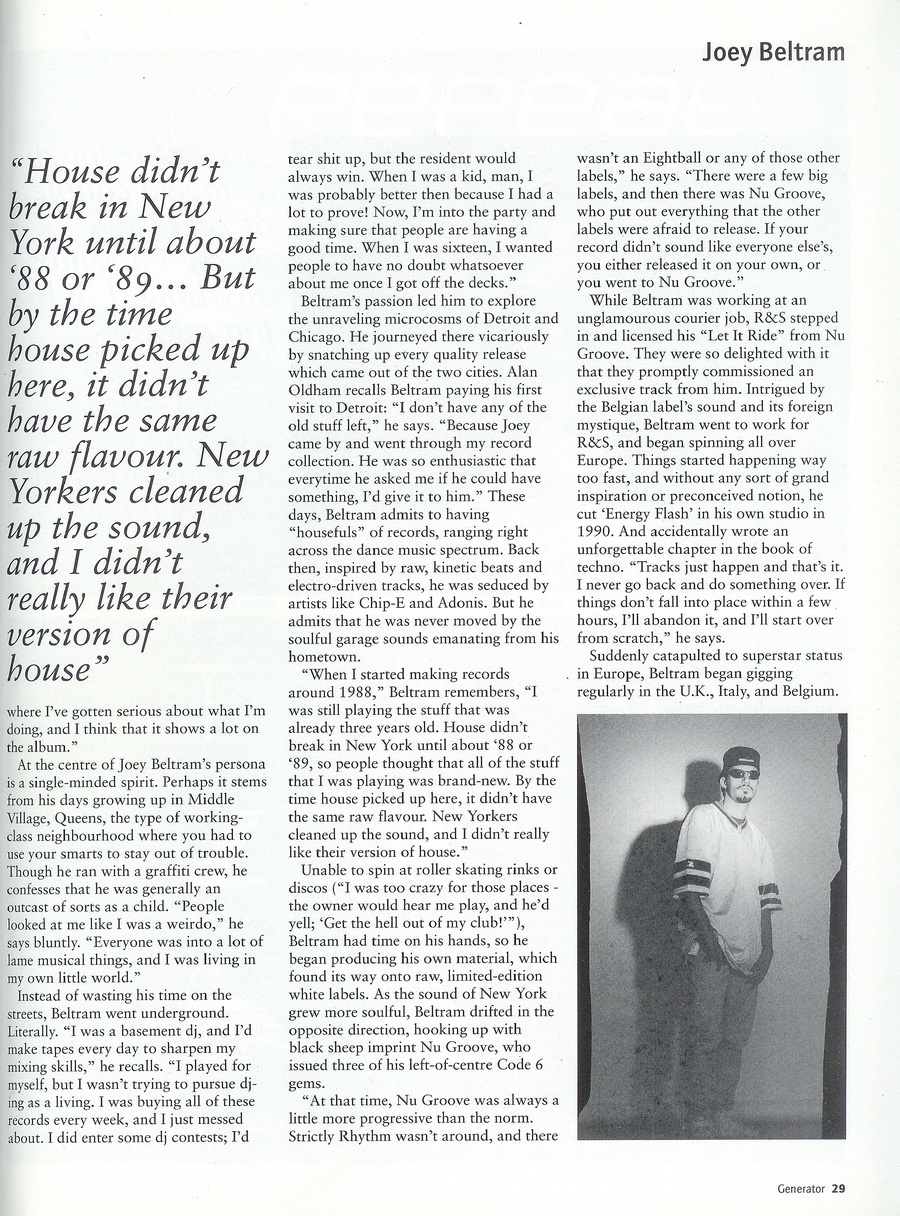
expect - except the white picket fence, of course. Aside from choosing Orange County for its bucolic charm, Beltram had a definitive reason for making the move: he wanted to get his life together, take his production career to the next level, and use the new surroundings as an inspiration for his music.
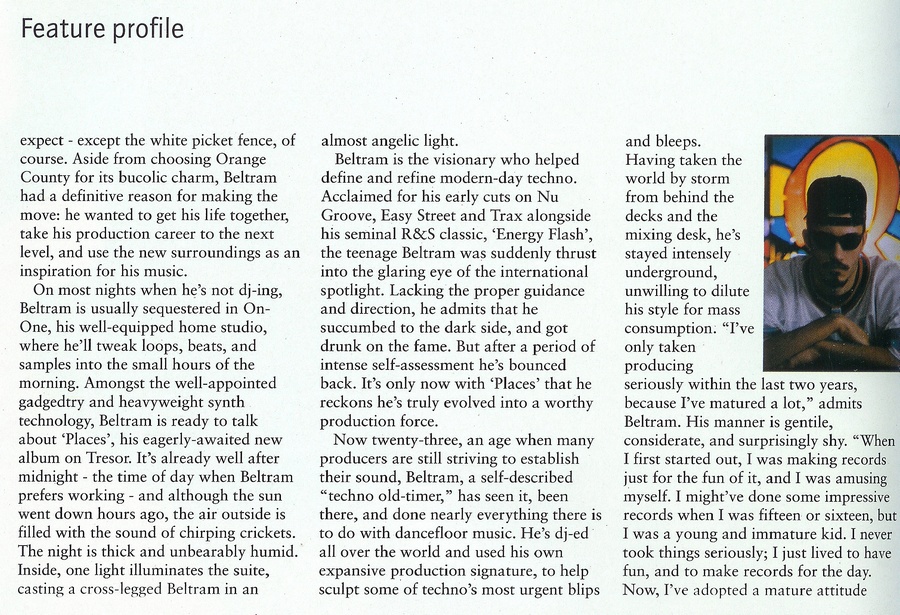
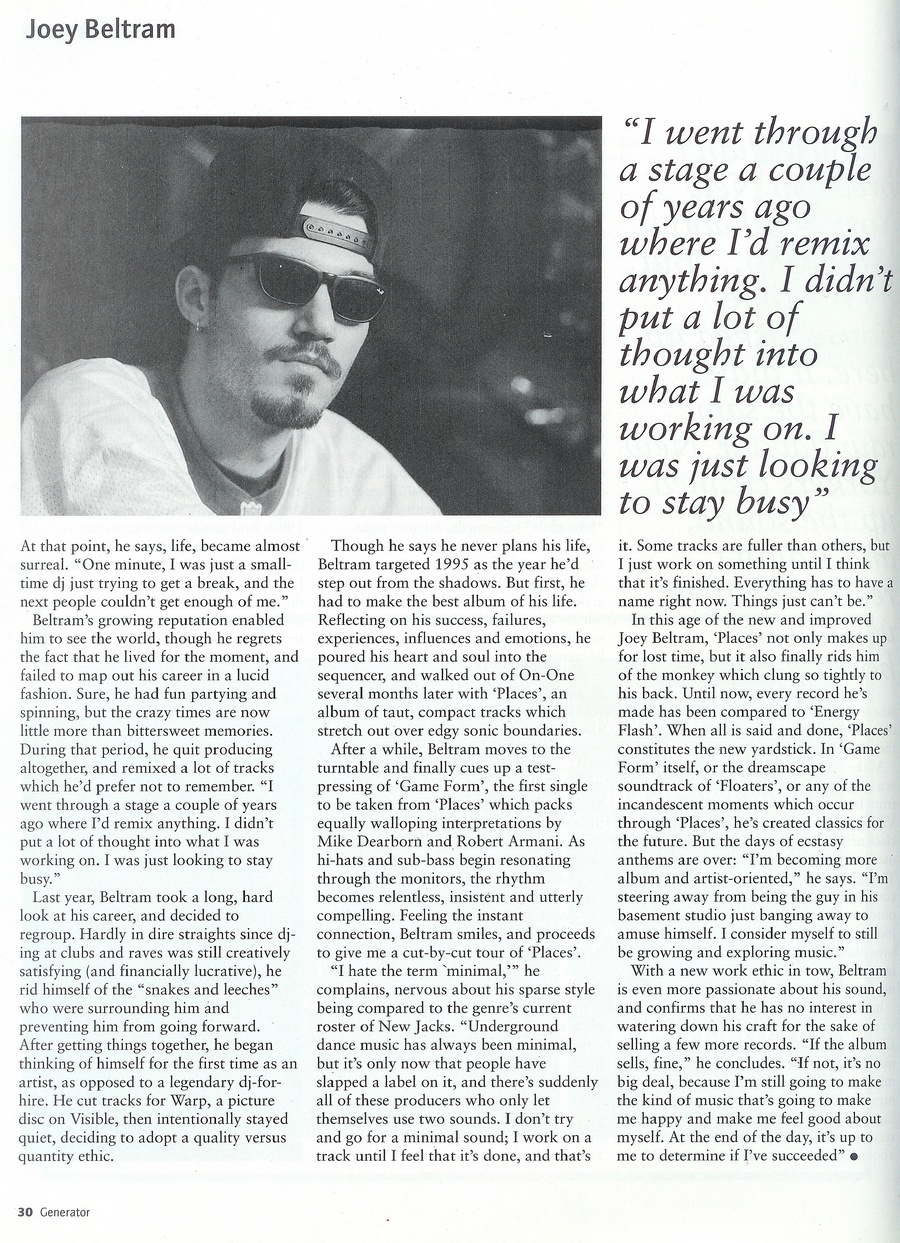
On most nights when he's not dj-ing, Beltram is usually sequestered in On-One, his well-equipped home studio, where he'll tweak loops, beats, and samples into the small hours of the morning. Amongst the well-appointed gadgetdry and heavyweight synth technology, Beltram is ready to talk about 'Places', his eagerly-awaited new album on Tresor. It's already well after midnight - the time of day when Beltram prefers working - and although the sun went down hours ago, the air outside is filled with the sound of chirping crickets. The night is thick and unbearably humid. Inside, one light illuminates the suite, casting a cross-legged Beltram in an almost angelic light.
Beltram is the visionary who helped define and refine modern-day techno. Acclaimed for his early cuts on Nu Groove, Easy Street and Trax alongside his seminal R&S classic, 'Energy Flash', the teenage Beltram was suddenly thrust into the glaring eye of the international spotlight. Lacking the proper guidance and direction, he admits that he succumbed to the dark side, and got drunk on the fame. But after a period of intense self-assessment he's bounced back. It's only now with 'Places' that he reckons he's truly evolved into a worthy production force.
Now twenty-three, an age when many producers are still striving to establish their sound, Beltram, a self-described "techno old-timer," has seen it, been there, and done nearly everything there is to do with dancefloor music. He's dj-ed all over the world and used his own expansive production signature, to help sculpt some of techno's most urgent blips and bleeps. Having taken the world by storm from behind the decks and the mixing desk, he's stayed intensely underground, unwilling to dilute his style for mass consumption. "I've only taken producing seriously within the last two years, because I've matured a lot," admits Beltram. His manner is gentle, considerate, and surprisingly shy. "When I first started out, I was making records just for the fun of it, and I was amusing myself. I might've done some impressive records when I was fifteen or sixteen, but I was a young and immature kid. I never took things seriously; I just lived to have fun, and to make records for the day. Now, I've adopted a mature attitude
Page 29
Interview
Joey Beltram
"House didn't break in New York until about '88 or '89... But by the time house picked up here, it didn't have the same raw flavour. New Yorkers cleaned up the sound, and I didn't really like their version of house"
where I've gotten serious about what I'm doing, and I think that it shows a lot on the album."
At the centre of Joey Beltram's persona is a single-minded spirit. Perhaps it stems from his days growing up in Middle Village, Queens, the type of working-class neighbourhood where you had to use your smarts to stay out of trouble. Though he ran with a graffiti crew, he confesses that he was generally an outcast of sorts as a child. "People looked at me like I was a weirdo," he says bluntly. "Everyone was into a lot of lame musical things, and I was living in my own little world."
Instead of wasting his time on the streets, Beltram went underground. Literally. "I was a basement dj, and I'd make tapes every day to sharpen my mixing skills," he recalls. "I played for myself, but I wasn't trying to pursue dj-ing as a living. I was buying all of these records every week, and I just messed about. I did enter some dj contests; I'd tear shit up, but the resident would always win. When I was a kid, man, I was probably better then because I had a lot to prove! Now, I'm into the party and making sure that people are having a good time. When I was sixteen, I wanted people to have no doubt whatsoever about me once I got off the decks."
Beltram's passion led him to explore the unraveling microcosms of Detroit and Chicago. He journeyed there vicariously by snatching up every quality release which came out of the two cities. Alan Oldham recalls Beltram paying his first visit to Detroit: "I don't have any of the old stuff left," he says. "Because Joey came by and went through my record collection. He was so enthusiastic that everytime he asked me if he could have something, I'd give it to him." These days, Beltram admits to having "housefuls" of records, ranging right across the dance music spectrum. Back then, inspired by raw, kinetic beats and electro-driven tracks, he was seduced by artists like Chip-E and Adonis. But he admits that he was never moved by the soulful garage sounds emanating from his hometown.
"When I started making records around 1988," Beltram remembers, "I was still playing the stuff that was already three years old. House didn't break in New York until about '88 or '89, so people thought that all of the stuff that I was playing was brand-new. By the time house picked up here, it didn't have the same raw flavour. New Yorkers cleaned up the sound, and I didn't really like their version of house."
Unable to spin at roller skating rinks or discos ("I was too crazy for those places - the owner would hear me play, and he'd yell; 'Get the hell out of my club!'"), Beltram had time on his hands, so he began producing his own material, which found its way onto raw, limited-edition white labels. As the sound of New York grew more soulful, Beltram drifted in the opposite direction, hooking up with black sheep imprint Nu Groove, who issued three of his left-of-centre Code 6 gems.
"At that time, Nu Groove was always a little more progressive than the norm. Strictly Rhythm wasn't around, and there wasn't an Eightball or any of those other labels," he says. "There were a few big labels, and then there was Nu Groove, who put out everything that the other labels were afraid to release. If your record didn't sound like everyone else's, you either released it on your own, or you went to Nu Groove."
While Beltram was working at an unglamourous courier job, R&S stepped in and licensed his "Let It Ride" from Nu Groove. They were so delighted with it that they promptly commissioned an exclusive track from him. Intrigued by the Belgian label's sound and its foreign mystique, Beltram went to work for R&S, and began spinning all over Europe. Things started happening way too fast, and without any sort of grand inspiration or preconceived notion, he cut 'Energy Flash' in his own studio in 1990. And accidentally wrote an unforgettable chapter in the book of techno. "Tracks just happen and that's it. I never go back and do something over. If things don't fall into place within a few hours, I'll abandon it, and I'll start over from scratch," he says.
Suddenly catapulted to superstar status in Europe, Beltram began gigging regularly in the U.K., Italy, and Belgium.
Generator 29
Page 30
Interview
Joey Beltram
"I went through a stage a couple of years ago where I'd remix anything. I didn't put a lot of thought into what I was working on. I was just looking to stay busy"
At that point, he says, life, became almost surreal. "One minute, I was just a small-time dj just trying to get a break, and the next people couldn't get enough of me."
Beltram's growing reputation enabled him to see the world, though he regrets the fact that he lived for the moment, and failed to map out his career in a lucid fashion. Sure, he had fun partying and spinning, but the crazy times are now little more than bittersweet memories. During that period, he quit producing altogether, and remixed a lot of tracks which he'd prefer not to remember. "I went through a stage a couple of years ago where I'd remix anything. I didn't put a lot of thought into what I was working on. I was just looking to stay busy."
Last year, Beltram took a long, hard look at his career, and decided to regroup. Hardly in dire straights since djing at clubs and raves was still creatively satisfying (and financially lucrative), he rid himself of the "snakes and leeches" who were surrounding him and preventing him from going forward. After getting things together, he began thinking of himself for the first time as an artist, as opposed to a legendary dj-for-hire. He cut tracks for Warp, a picture disc on Visible, then intentionally stayed quiet, deciding to adopt a quality versus quantity ethic.
Though he says he never plans his life, Beltram targeted 1995 as the year he'd step out from the shadows. But first, he had to make the best album of his life. Reflecting on his success, failures, experiences, influences and emotions, he poured his heart and soul into the sequencer, and walked out of On-One several months later with 'Places', an album of taut, compact tracks which stretch out over edgy sonic boundaries.
After a while, Beltram moves to the turntable and finally cues up a test-pressing of 'Game Form', the first single to be taken from 'Places' which packs equally walloping interpretations by Mike Dearborn and Robert Armani. As hi-hats and sub-bass begin resonating through the monitors, the rhythm becomes relentless, insistent and utterly compelling. Feeling the instant connection, Beltram smiles, and proceeds to give me a cut-by-cut tour of 'Places'.
"I hate the term 'minimal,'" he complains, nervous about his sparse style being compared to the genre's current roster of New Jacks. "Underground dance music has always been minimal, but it's only now that people have slapped a label on it, and there's suddenly all of these producers who only let themselves use two sounds. I don't try and go for a minimal sound; I work on a track until I feel that it's done, and that's it. Some tracks are fuller than others, but I just work on something until I think that it's finished. Everything has to have a name right now. Things just can't be."
In this age of the new and improved Joey Beltram, 'Places' not only makes up for lost time, but it also finally rids him of the monkey which clung so tightly to his back. Until now, every record he's made has been compared to 'Energy Flash'. When all is said and done, 'Places' constitutes the new yardstick. In 'Game Form' itself, or the dreamscape soundtrack of 'Floaters', or any of the incandescent moments which occur through 'Places', he's created classics for the future. But the days of ecstasy anthems are over: "I'm becoming more album and artist-oriented," he says. "I'm steering away from being the guy in his basement studio just banging away to amuse himself. I consider myself to still be growing and exploring music."
With a new work ethic in tow, Beltram is even more passionate about his sound, and confirms that he has no interest in watering down his craft for the sake of selling a few more records. "If the album sells, fine," he concludes. "If not, it's no big deal, because I'm still going to make the kind of music that's going to make me happy and make me feel good about myself. At the end of the day, it's up to me to determine if I've succeeded"
Page 32
Feature
Feature profile
Photek
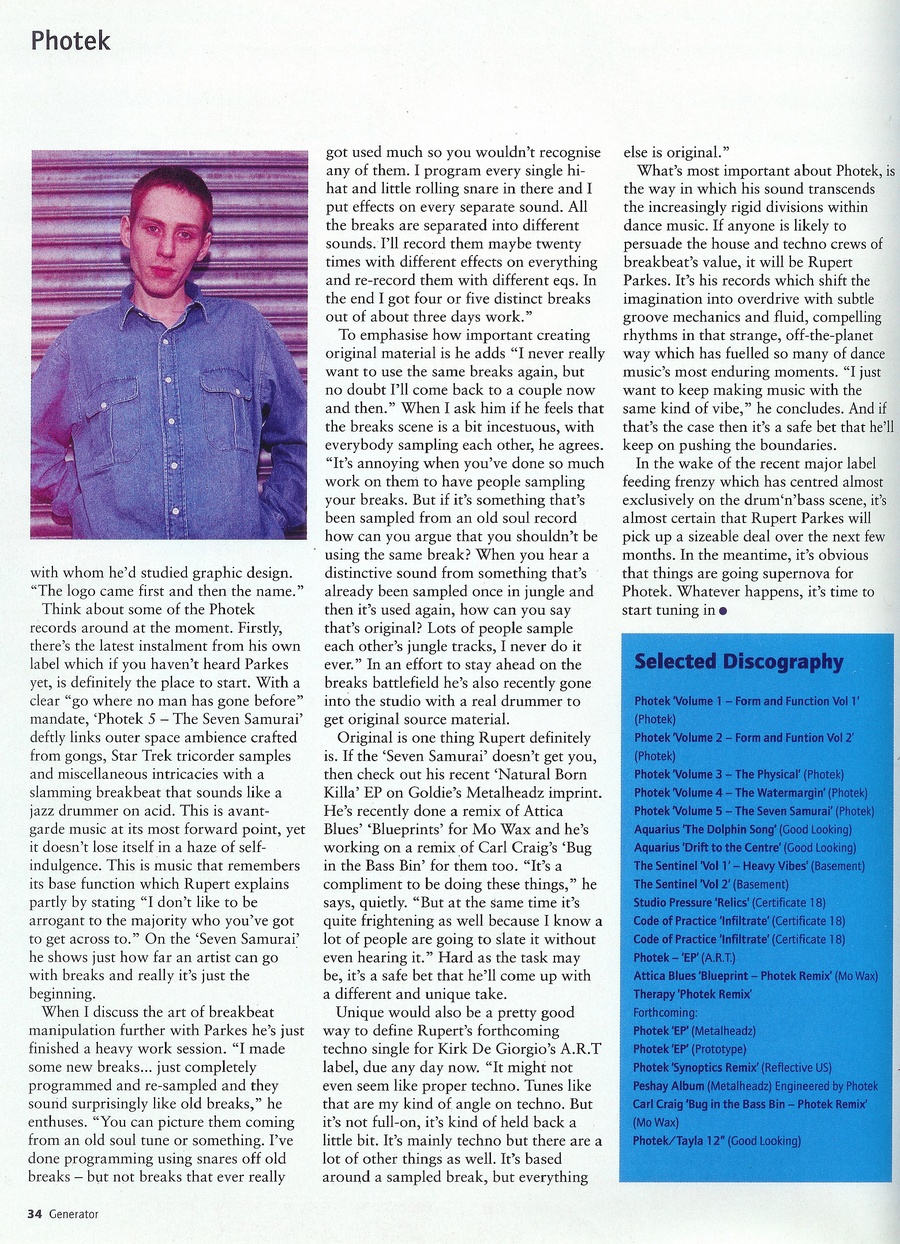
Rupert Parkes is stretching the envelope of drum'n'bass through jazz and techno towards "outer space ambience". His records are full of intricate details and hot-wired breaks. Now, he's picking up interest from major labels. Is he the future of jungle? Or just another white kid kicking through the traces of someone else's music? Gamall Awad gets the story. Pat Pope gets the pictures.
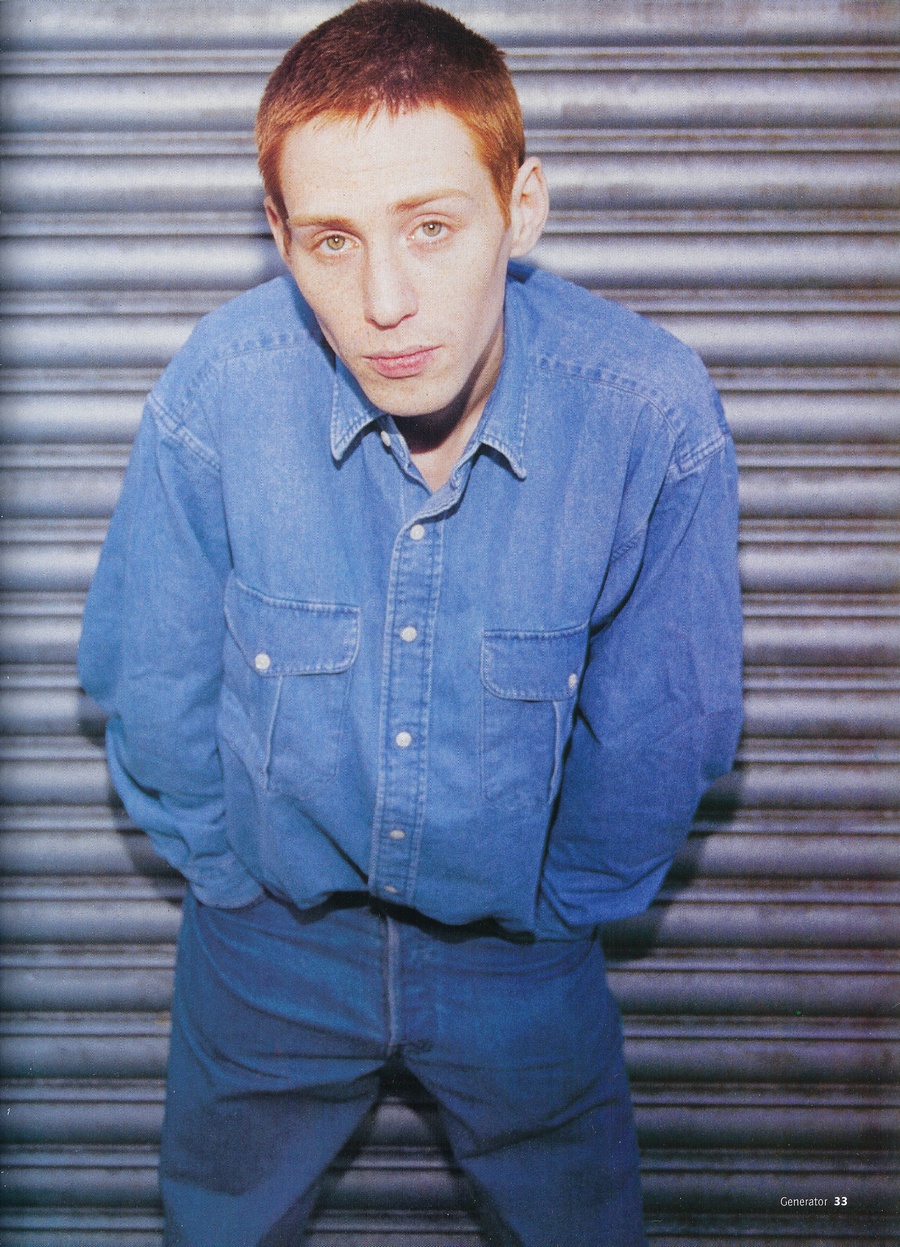
At only 23, Rupert Parkes has proved himself to be one of the busiest recording artists around. In the last two years he's released a constant and consistent stream of quality twelves under guises like Photek, Aquarius, Studio Pressure, Sentinel and Code of Practice for labels such as Good Looking, Certificate 18, Basement, Mo Wax and his own Photek imprint. In the process he's crafted a major reputation, cited by the broadest possible range of creative talents – from Goldie and Grooverider to Kirk De Giorgio and Jonah Sharp to Gilles Peterson and James Lavelle – as being an "innovator", "someone to watch," "the cutting edge". He's also been vehemently attacked by one critic, who attempted, without proper research, to label him as one of jungle's bandwagon jumpers.
Whatever you've read, it's all irrelevant. The music is what counts. Parkes is an artist for our times. His concerns and work don't belong in the pigeon-holes and narrow margins being drawn around him. As an artist he's a shape-shifter who's just beginning to show how many different entities he can be. His work belongs alongside that of Reinforced's Dego and Mark (4 Hero, Nu-era, Manix, Tom and Jerry) and Evolution's Tom and Mark (Reload, Global Communication, Chaos and Julia Set, Appaloosa, Jedi Knights). It transcends boundaries. Breaks the rules. Reformats the scheme of things, like a new mutant strand of a killer virus.
Parkes began making music about three years ago when he moved from his home town of St Albans to Ipswich. He started working in a record shop where most of his time was spent listening to hip-hop, electro and classic techno. But it was the long sessions listening to saxophonist John Coltrane and jazz avant-gardists like Lester Bowie which really instilled his desire to make music. His first instrument was the tenor sax. The horn-playing phase was short-lived however, primarily due to the fact that he "had no desire to read music at all." What he quickly decided was that he really wanted to "have control over the overall sound, the final product of a track. I wanted to create something that couldn't be done on just one instrument. That's why I got into electronic music."
Starting out with only a basic sampler he began manipulating sounds. "The first couple of pieces I did, I tried to use some percussion samples from garage records because I didn't have a drum machine. But that didn't really work. After that I really got into the breakbeat thing, because it was the only way I could complete a tune." At the time, all he wanted to do was to take elements "from all the songs I ever heard and blend them together all into one. I wanted all these different things to be fused together, whether they were rare groove or classic techno or whatever. I was into all these different experiences I was having around the different types of music. What I liked about doing breakbeat was that I could put all these styles together and twist it and that was fine. Drum'n'bass has always been about doing what you wanted as long as it sounds good."
In early 1992, Rupert hooked up with a friend, Rob, who'd already released a couple of underground twelves under the name Origination and the two began collaborating. Over the next year they sampled breaks and reggae samples and even did the odd PA. The flavour of Parkes' work from this period confirms his solid base within the jungle/drum'n'bass scene. His story and the development of his sound go hand in hand with the development of the music itself. Which partly explains why Rupert gets so much respect from his breakbeat peers.
Another reason is his staunch individualistic approach which all started with his solo debut 'Mark One' for Ipswich-based Certificate 18. The record was released under the name Studio Pressure, the first in a long line of pseudonyms and project titles. "I think that the alias' scenario is partly putting on a face in case an experiment goes wrong," explains Parkes. "It's also to keep credibility with fans who like one of your styles but might think you're selling out if they hear another."
But it's his work as Photek which has really captured the imagination, records which push sounds into flight and nail down long, loose-limbed breaks, blurring the boundaries between techno and breakbeat. Parkes has now decided to use the name Photek for all his projects. "It's just basically a way of saying that I like all the music I do," he offers. "I don't really make anything that I don't like and I'm saying I want to put my name to it." The name Photek came from a friend
32 Generator
Page 33
Generator 33
Page 34
Interview
Photek
with whom he'd studied graphic design. "The logo came first and then the name."
Think about some of the Photek records around at the moment. Firstly, there's the latest instalment from his own label which if you haven't heard Parkes yet, is definitely the place to start. With a clear "go where no man has gone before" mandate, 'Photek 5 – The Seven Samurai' deftly links outer space ambience crafted from gongs, Star Trek tricorder samples and miscellaneous intricacies with a slamming breakbeat that sounds like a jazz drummer on acid. This is avant-garde music at its most forward point, yet it doesn't lose itself in a haze of self-indulgence. This is music that remembers its base function which Rupert explains partly by stating "I don't like to be arrogant to the majority who you've got to get across to." On the 'Seven Samurai' he shows just how far an artist can go with breaks and really it's just the beginning.
When I discuss the art of breakbeat manipulation further with Parkes he's just finished a heavy work session. "I made some new breaks... just completely programmed and re-sampled and they sound surprisingly like old breaks," he enthuses. "You can picture them coming from an old soul tune or something. I've done programming using snares off old breaks – but not breaks that ever really
got used much so you wouldn't recognise any of them. I program every single hi-hat and little rolling snare in there and I put effects on every separate sound. All the breaks are separated into different sounds. I'll record them maybe twenty times with different effects on everything and re-record them with different eqs. In the end I got four or five distinct breaks out of about three days work."
To emphasise how important creating original material is he adds "I never really want to use the same breaks again, but no doubt I'll come back to a couple now and then." When I ask him if he feels that the breaks scene is a bit incestuous, with everybody sampling each other, he agrees. "It's annoying when you've done so much work on them to have people sampling your breaks. But if it's something that's been sampled from an old soul record how can you argue that you shouldn't be using the same break? When you hear a distinctive sound from something that's already been sampled once in jungle and then it's used again, how can you say that's original? Lots of people sample each other's jungle tracks, I never do it ever." In an effort to stay ahead on the breaks battlefield he's also recently gone into the studio with a real drummer to get original source material.
Original is one thing Rupert definitely is. If the 'Seven Samurai' doesn't get you, then check out his recent 'Natural Born Killa' EP on Goldie's Metalheadz imprint. He's recently done a remix of Attica Blues' 'Blueprints' for Mo Wax and he's working on a remix of Carl Craig's 'Bug in the Bass Bin' for them too. "It's a compliment to be doing these things," he says, quietly. "But at the same time it's quite frightening as well because I know a lot of people are going to slate it without even hearing it." Hard as the task may be, it's a safe bet that he'll come up with a different and unique take.
Unique would also be a pretty good way to define Rupert's forthcoming techno single for Kirk De Giorgio's A.R.T label, due any day now. "It might not even seem like proper techno. Tunes like that are my kind of angle on techno. But it's not full-on, it's kind of held back a little bit. It's mainly techno but there are a lot of other things as well. It's based around a sampled break, but everything
else is original."
What's most important about Photek, is the way in which his sound transcends the increasingly rigid divisions within dance music. If anyone is likely to persuade the house and techno crews of breakbeat's value, it will be Rupert Parkes. It's his records which shift the imagination into overdrive with subtle groove mechanics and fluid, compelling rhythms in that strange, off-the-planet way which has fuelled so many of dance music's most enduring moments. "I just want to keep making music with the same kind of vibe," he concludes. And if that's the case then it's a safe bet that he'll keep on pushing the boundaries.
In the wake of the recent major label feeding frenzy which has centred almost exclusively on the drum'n'bass scene, it's almost certain that Rupert Parkes will pick up a sizeable deal over the next few months. In the meantime, it's obvious that things are going supernova for Photek. Whatever happens, it's time to start tuning in ●
Selected Discography
Photek 'Volume 1 – Form and Function Vol 1' (Photek)
Photek 'Volume 2 – Form and Funtion Vol 2' (Photek)
Photek 'Volume 3 – The Physical' (Photek)
Photek 'Volume 4 – The Watermargin' (Photek)
Photek 'Volume 5 – The Seven Samurai' (Photek)
Aquarius 'The Dolphin Song' (Good Looking)
Aquarius 'Drift to the Centre' (Good Looking)
The Sentinel 'Vol 1' – Heavy Vibes' (Basement)
The Sentinel 'Vol 2' (Basement)
Studio Pressure 'Relics' (Certificate 18)
Code of Practice 'Infiltrate' (Certificate 18)
Code of Practice 'Infiltrate' (Certificate 18)
Photek – 'EP' (A.R.T)
Attica Blues 'Blueprint – Photek Remix' (Mo Wax)
Therapy 'Photek Remix'
Forthcoming:
Photek 'EP' (Metalheadz)
Photek 'EP' (Prototype)
Photek 'Synoptics Remix' (Reflective US)
Peshay Album (Metalheadz) Engineered by Photek
Carl Craig 'Bug in the Bass Bin – Photek Remix' (Mo Wax)
Photek/Tayla 12" (Good Looking)
34 Generator
Page 37
Interview
Profile
Lemon D.
Text Colin Steven
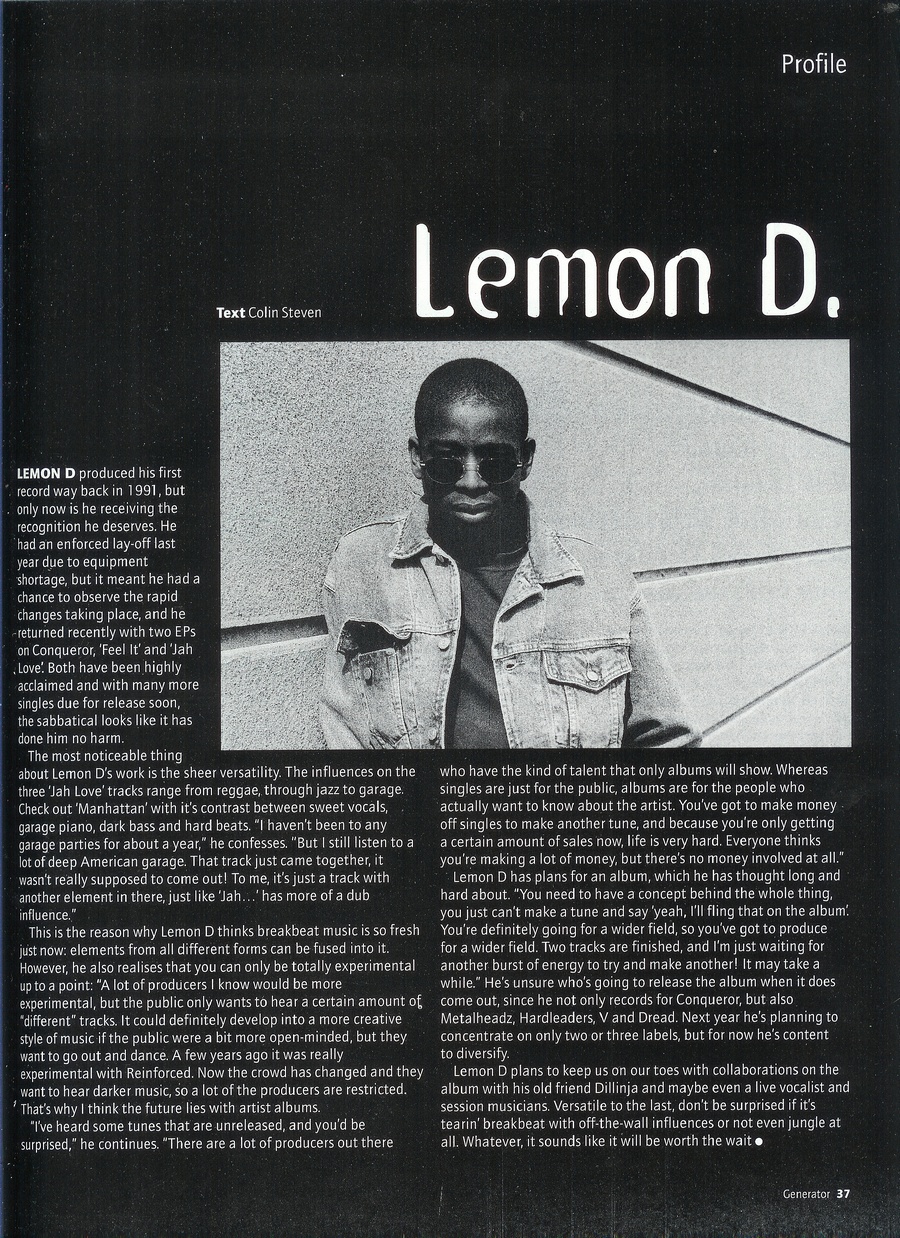
LEMON D produced his first record way back in 1991, but only now is he receiving the recognition he deserves. He had an enforced lay-off last year due to equipment shortage, but it meant he had a chance to observe the rapid changes taking place, and he returned recently with two EPs on Conqueror, 'Feel It' and 'Jah Love'. Both have been highly acclaimed and with many more singles due for release soon, the sabbatical looks like it has done him no harm.
The most noticeable thing about Lemon D's work is the sheer versatility. The influences on the three 'Jah Love' tracks range from reggae, through jazz to garage. Check out 'Manhattan' with it's contrast between sweet vocals, garage piano, dark bass and hard beats. "I haven't been to any garage parties for about a year," he confesses. "But I still listen to a lot of deep American garage. That track just came together, it wasn't really supposed to come out! To me, it's just a track with another element in there, just like 'Jah…' has more of a dub influence."
This is the reason why Lemon D thinks breakbeat music is so fresh just now: elements from all different forms can be fused into it. However, he also realises that you can only be totally experimental up to a point: "A lot of producers I know would be more experimental, but the public only wants to hear a certain amount of 'different' tracks. It could definitely develop into a more creative style of music if the public were a bit more open-minded, but they want to go out and dance. A few years ago it was really experimental with Reinforced. Now the crowd has changed and they want to hear darker music, so a lot of the producers are restricted. That's why I think the future lies with artist albums.
"I've heard some tunes that are unreleased, and you'd be surprised," he continues. "There are a lot of producers out there who have the kind of talent that only albums will show. Whereas singles are just for the public, albums are for the people who actually want to know about the artist. You've got to make money off singles to make another tune, and because you're only getting a certain amount of sales now, life is very hard. Everyone thinks you're making a lot of money, but there's no money involved at all."
Lemon D has plans for an album, which he has thought long and hard about. "You need to have a concept behind the whole thing, you just can't make a tune and say 'yeah, I'll fling that on the album'. You're definitely going for a wider field, so you've got to produce for a wider field. Two tracks are finished, and I'm just waiting for another burst of energy to try and make another! It may take a while." He's unsure who's going to release the album when it does come out, since he not only records for Conqueror, but also Metalheadz, Hardleaders, V and Dread. Next year he's planning to concentrate on only two or three labels, but for now he's content to diversify.
Lemon D plans to keep us on our toes with collaborations on the album with his old friend Dillinja and maybe even a live vocalist and session musicians. Versatile to the last, don't be surprised if it's tearin' breakbeat with off-the-wall influences or not even jungle at all. Whatever, it sounds like it will be worth the wait.
Generator 37
Page 42
Feature
Comment
As the dance music underground moves increasingly towards the mainstream, the major record retail chains have discovered that there's money to be made from house, techno and breakbeat. But where does that leave the independent shops? For the last ten years, they've sourced our records and supported artists and labels alike. Now they're under pressure. And if we lose them,
Endangered
the consequences for the dance scene could be profound. Whether you buy your records at Trax or Lucky Spin, Wind Up or 23rd Precinct, or any one of the hundreds of dedicated independent stores across the country, what you are about to read is important...
42 Generator
Page 43
Feature
Endangered Species
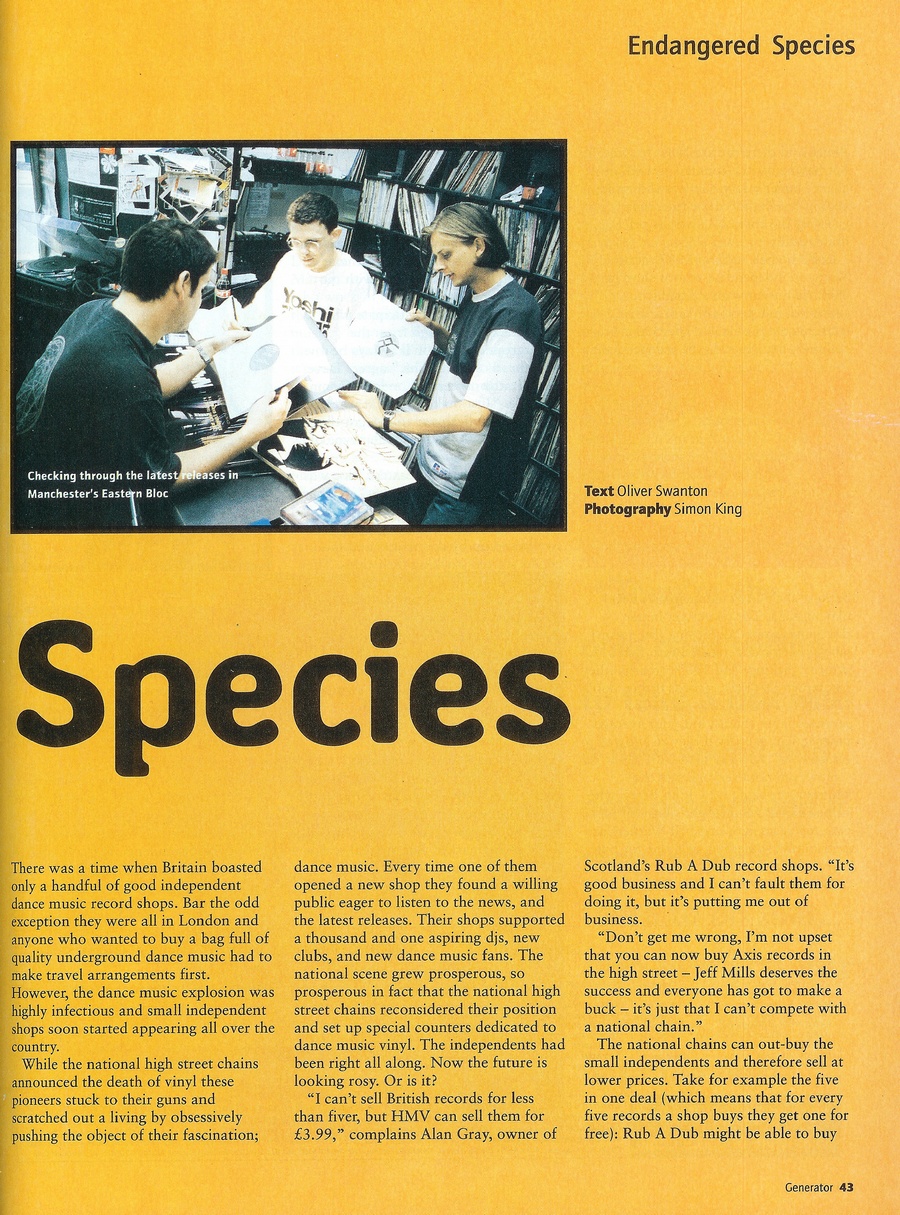
Checking through the latest releases in Manchester's Eastern Bloc
Text Oliver Swanton
Photography Simon King
Species
There was a time when Britain boasted only a handful of good independent dance music record shops. Bar the odd exception they were all in London and anyone who wanted to buy a bag full of quality underground dance music had to make travel arrangements first. However, the dance music explosion was highly infectious and small independent shops soon started appearing all over the country.
While the national high street chains announced the death of vinyl these pioneers stuck to their guns and scratched out a living by obsessively pushing the object of their fascination; dance music. Every time one of them opened a new shop they found a willing public eager to listen to the news, and the latest releases. Their shops supported a thousand and one aspiring djs, new clubs, and new dance music fans. The national scene grew prosperous, so prosperous in fact that the national high street chains reconsidered their position and set up special counters dedicated to dance music vinyl. The independents had been right all along. Now the future is looking rosy. Or is it?
"I can't sell British records for less than fiver, but HMV can sell them for £3.99," complains Alan Gray, owner of Scotland's Rub A Dub record shops. "It's good business and I can't fault them for doing it, but it's putting me out of business.
"Don't get me wrong, I'm not upset that you can now buy Axis records in the high street – Jeff Mills deserves the success and everyone has got to make a buck – it's just that I can't compete with a national chain."
The national chains can out-buy the small independents and therefore sell at lower prices. Take for example the five in one deal (which means that for every five records a shop buys they get one for free): Rub A Dub might be able to buy
Generator 43
Page 21
Feature
Comment
fifteen and therefore get three for free, but buying for the country as a whole a chain's buyer might buy two thousand, getting four hundred for free, thus enabling the chain to lower its prices dramatically.
Rob Mitchell, who in 1987 set up Warp, an independent record shop in Sheffield and now also a highly successful independent record label, confirms the problem: "The chains are definitely endangering the independents because they don't compete on a level playing field. The chains get better discounts, co-op advertising (the record labels pay for adverts in return for priority racking) and 100% returns (they can return all of the records if they don't sell them). We regularly get 66% returned from chains, but your average independent is lucky if they're allowed to return 5%."
However, not everyone sees the situation the same way. John Berry, who helped set up Manchester's Eastern Bloc over ten years ago, says; "If Warners are distributing something as a one for one and the chains are flogging it out of a bucket for £1.99 then why bother? Sell the promos and the import copies, but don't bother competing with the chains on their own turf.
"You're never going to earn big bucks running an independent, it's a cutting edge thing," he continues. "You survive on the edge by capitalising on the next big thing, not by competing with the chains."
"If you can always anticipate what's going to come through from the underground then you'll always be one step ahead of the chains," agrees Dave Wesson, the owner of London's Zoom Records. "Just make sure that when the music goes full-blown you've got the largest range of that particular type of music."
During the eighties, Eastern Bloc was "hammering the indie market", but saw the writing on the wall when smaller independent labels started getting swallowed up by the majors and the chains started stocking their titles. They moved out of the indie market and into house and techno. When Zoom opened in Camden High Street five years ago they concentrated on Italian house, flying over and buying direct, before the distributors cottoned on. When that sound went mainstream, they switched to trance. Both shops survived competition from the chains by not competing with them at all.
"I'll not deny that it's difficult," admits John Berry. "If you keep to your original vision then you're probably going to go out of business. The profit margins are crap and the chains are always chipping away at the market. But the real reason a lot of independents are going out of business is because they don't know the business.
"A lot of people saw what independents like us were doing in 1990 and thought they could do the same thing in their home towns. Now there are too many shops and some of them are going to have to go. It won't matter because the market that's left is still the same and the shops that are left will be more streamlined."
However, there is a more convincing school of thought which argues that the larger the number of independents, the larger the market for dance music. All the small independents, in towns all over the country, passionately push and support the music they love and increase
Page 45
Feature
the market as a whole. If they disappeared, the market for dance music would contract.
The disappearance of the independents would also mean the loss of a valuable support network for underground artists and newly emerging labels. "Small labels like mine depend on the independent shops," reckons Mark Broom, whose new Pure Plastic imprint is just about to release its fifth record. "Without them, no one would be able to buy our records and it would be like the old days and we'd been driving around the country selling our records out of the back of a van."
"They're the only ones willing to take a risk with a new sound and new project and if they weren't there to do that, then new acts just wouldn't make it onto the high street shelves," says Rob Mitchell, who, when Warp released 'Artificial Intelligence 1', commissioned an advert listing and thanking all the independent shops where the record could be bought.
The loss of the independents would also mean the loss of the kind of knowledgeable, passionate music lovers like Alan Gray, who set up his Rub A Dub record shops, with his partner Martin, on a shoe-string. "The people who work in independents are lifers – they're in it because they love the music," he says. "Sometimes I've been in the shop until nine o'clock at night, but it's cool because I'd rather be here listening to records than sitting at home watching telly."
And it's that kind of passionate service which is duplicated behind independent counters all over the country. The kind of passion that means they make an effort to push records and artists they believe in. "Under my counter right now I can see all the Basic Channel back catalogue in quantities of twenty-five and more," enthuses Alan. "I've sold the whole Underground Resistance back catalogue four times over, and we bought them right off Mike Banks. The bigger shops are only interested in new records, but people have got to be able to hear the history of the current dance scene."
In London highly successful shops like Fat Cat can afford to specialise because they have a huge market of people to tap into. However, they're still aware of the problems facing independents in smaller towns.
"I've been there," says Dave Cawley, who use to run a shop in Sussex, before opening Fat Cat in London. "I can remember plenty of distributors who had a real problem dealing with us. Distributors need to have more patience with the small shops that can only afford to buy in five records at a time, because when you forget about them you might
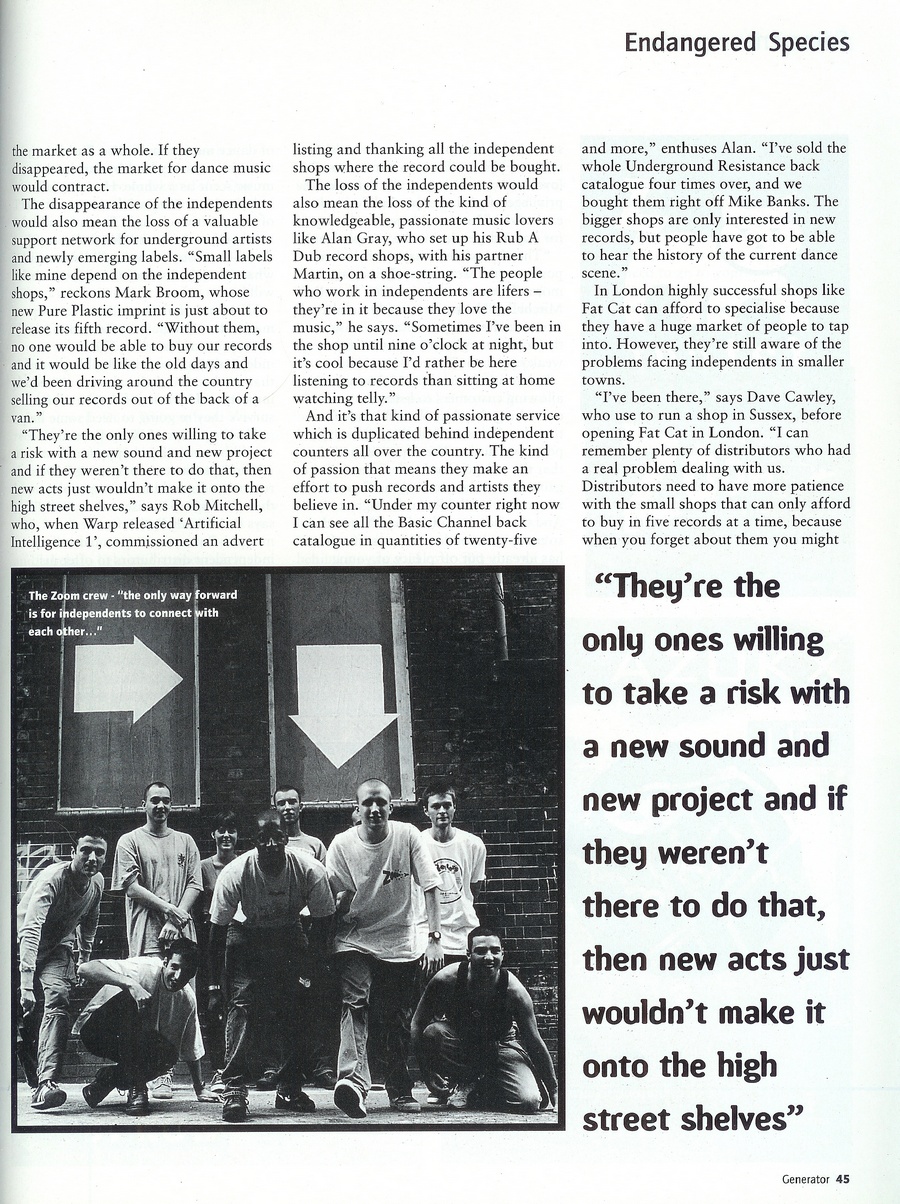
The Zoom crew - "the only way forward is for independents to connect with each other..."
"They're the only ones willing to take a risk with a new sound and new project and if they weren't there to do that, then new acts just wouldn't make it onto the high street shelves"
Generator 45
Page 23
Feature
Comment
as well give it all up to the chains now.
"I know it's a lot of work to send out lots of small orders," he continues. "But when the Fat Cat label starts later this year, I don't care how much work it is to service the small shops – we'll be doing it."
The larger, more established, independents will almost certainly survive the current squeeze from the national chains. Their customer base is loyal and prefers to pay the extra for the privilege of getting expert advice and exclusives. However, there is no reason for any independent to be complacent.
"The chains aren't happy with their position and are constantly looking for more and more market share," says Rob Mitchell. "The easiest people to take it from are the independents, because they're a disorganised and therefore weak opponent."
Independents who pride themselves on allowing customers to listen to everything they buy should be aware that the chains are installing listening posts and decks. The expert knowledge that the independents offer is easily gained from the growing number of magazines available on the high street. And the moody elitist dj syndrome that so many independent shops suffer from has already put off plenty of young customers.
National chains selling large quantities of dance music vinyl isn't a bad thing; in fact it's extremely healthy for the dance music scene as a whole. However, the independents must not become victims of this positive change. They provide an invaluable service and the chains need them – without them they'll have no idea what tomorrow's music, artist, or label will be.
There isn't an independent record market and a high street record market, just one record market. The independents are an invaluable part of that market and their sales are incredibly important. However, if they're all to survive they're going to need some help.
"As the owner of Warp Records I would be more than happy for the top 120 independent shops getting 25% returns and would have no problem with them having a 5% discount as well," says Rob Mitchell. "In fact at the moment I'm trying to persuade all the independent distributors to offer just those kind of incentives. If the distributors let the independents go
Page 24
Feature
Endangered Species
under, they'll be kicking themselves in five years time when they've got a new band they need to break and the Our Price buyer says, "Sorry, I've never heard of them'."
"Basically we've survived and prospered because we've got good relationships with artists/independent record labels and they sort us out properly," says Dave Cawley, from Fat Cat. "The smaller independents have got to start ringing up the labels and artists they sell and get them to support their shops."
And the independents can help each other as well. Dave Wesson from Zoom recently took part in an attempt to set up an association of independent retailers, that would attempt to mirror the bulk-buying power of a major high street chain. "I've always believed that the only way forward for the independents is to connect with other like-minded shops and labels to help and support each other," he says. However, the proposed association has yet to become a reality.
Other shops have already taken different routes to ensure their financial security. Two years ago Eastern Bloc was on its last financial legs, when suddenly they took a shock decision which left Manchester's record buyers reeling. They accepted a buy out from Pete Waterman's PWL company. However, since the PWL product has not lined the walls and in fact Eastern Bloc looks healthier than ever, with several new specialist counters. Pete Waterman now owns another ten independent shops.
Using your shop as an A&R base can also help an independent's profile and bank balance. "At first the shops profits kept the label afloat, but now increasingly it's the other way around," says Dave Wesson, from Zoom. "It leaves you in a perfect position – the shop can act as an A&R outpost and the label can sell to the shop at a discount. You can really shift a record if you get behind it – we sold over 500 units of Herbal Infusion in our own shop."
However, most of all the independents need the support of the record buying public. "I just want people not to get complacent about their independents," says Alan Gray. "Don't walk into these major shops and think that because they've got half a dozen trendy labels on their racks that's it and you don't need to go to your independent anymore. You have to keep on supporting the independents because if you don't we're just not going to be here tomorrow."
Page 52
Feature
Feature profile
52 Generator
Page 53
Interview
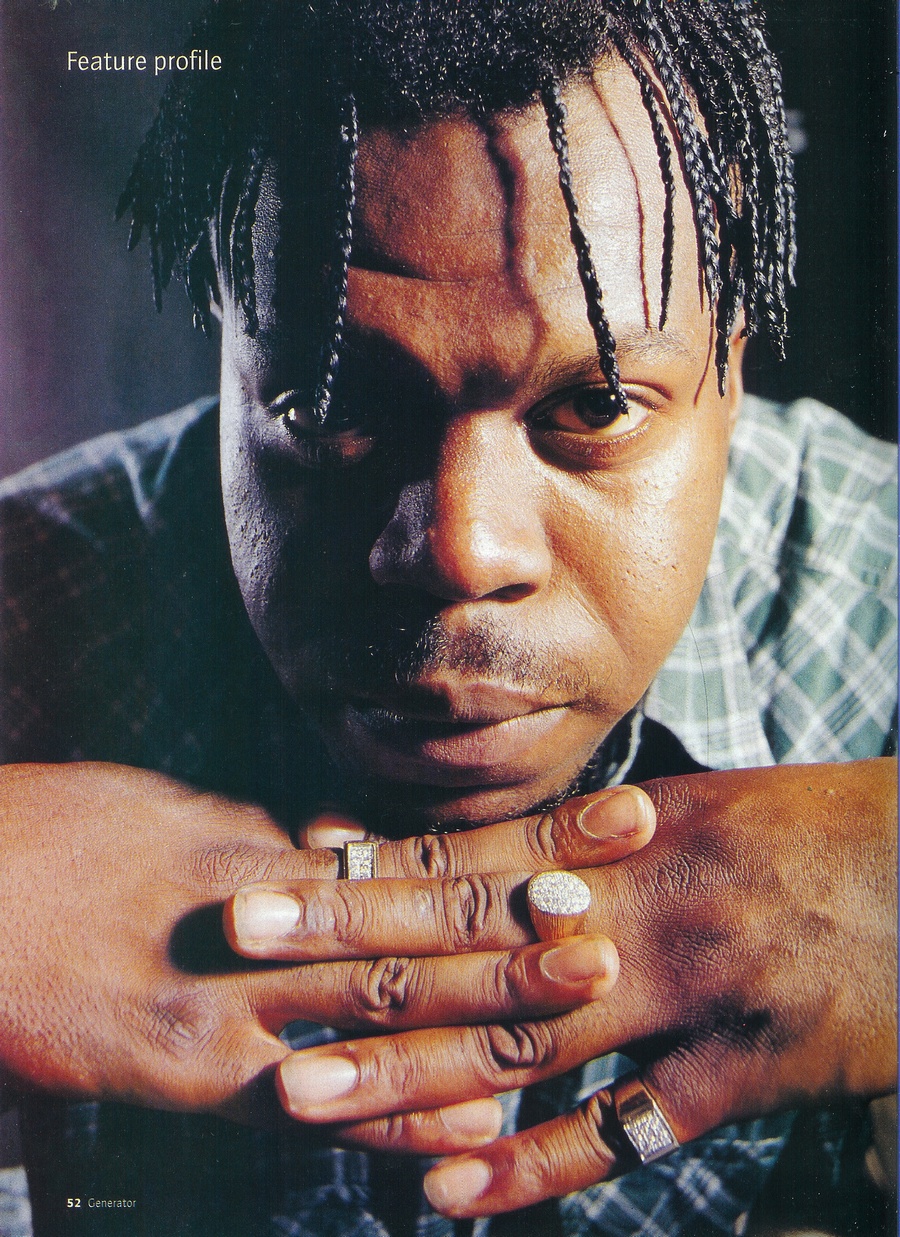
Immaculate deck skills and a no-nonsense attitude have made him one of the most popular djs on the breakbeat scene. From Centreforce FM to The Ministry of Sound, he's rocked the house with a sophisticated blend of raw, jump up cuts and smooth drum'n'bass. "I'm just flexing through the styles," he reckons...
Randall
Text Luke Howe
Photography Gideon
"The beats are definitely running," grins Randall as he steers his sleek, expensive BMW through the late afternoon traffic. The car stereo is turned way up and dense, intricate rhythms ricochet purposefully around the interior, weaving sinuous chord changes around heavy muscular basslines. The vocals, when they come, hit hard, punctuating the music with fluid, elliptical phrases which sigh momentarily before the bass drops back in. Randall nods approvingly. As the tape rolls on, he delivers a running commentary, namechecking the tunes and expressing wide-eyed admiration whenever a particularly fine break tumbles from the speakers. "Things are progressing so fast at the minute," he enthuses. "What I'm hearing now, what people like Dillinja, Steve Gurley, Aphrodite and Andy C are all doing with the beats and vocals and other stuff is... basically it's the bollocks!"
Huddled in a small office in East London, earlier that same afternoon, Randall's conversation is shot through with the kind of infectious enthusiasm that only real fans possess. His face creases into a broad grin when he remembers going up to Yikes in Slough with Frost, back in the days before a scene even existed. He laughs delightedly when he recalls hearing Gerald's '28 Gun Bad Boy' for the very first time. He'll happily talk about what makes Grooverider special, say, or any of the djs
Generator 53
Page 54
Feature
he plays alongside at AWOL. But when it comes to talking about himself, he's more reserved. "I don't do those kind of interviews," he says stonily, at one point.
But, eventually, he relents and begins tracing back through the years of a career which began when he was a messenger at the World Trades Centre. "I had to prove that I could do this," he recalls, wryly. "It wasn't runnin' with my mum, y'know. Stayin' home all day, playing records. Where was the future in it?" Back then, he was deeply into hip hop, switched on by his older brother's record collection. "I used to do tapes when I was thirteen or fourteen," he remembers. "I had access to all this music and I had a mate who had a pair of Technics. He showed me the basics, but I couldn't afford Technics, so I got a normal set of decks with pitch controls and I taught myself the rest on those."
When the first Transmat records reached England, Randall began mixing them in with hip hop and then reggae. "I used to do tapes and take 'em down the youth centre with my crew. At the time, I'd only been to a couple of raves – Dungeon down at Lea Bridge Road and Hypnosis with Rhythm Doctor – and somehow one of my tapes got passed to the people who were running Delerium. They gave me a Thursday night slot and then they asked me back to do the Saturday. And I got paid! So I bought some more records with the money and, when I played on the Saturday, the guys from Centreforce asked me if I wanted to do a show. So, after waiting and waiting, I went from playing in my bedroom to having a radio show in about a month."
On London's coolest pirate station, Randall's reputation began building. Even now, there are people who still have tapes of Randall's shows from those days, marked out by seamless mixing and the kind of versatile programming skills he'd developed to cope with his broad tastes. "I was privileged," he admits, quietly. "I was only about eighteen or nineteen, and I was playing on the radio station that everyone was listening to. Centreforce stayed on the air, twenty-four seven, for a long time, because that's the name of the game with a pirate – the longer you're around, the
more people are likely to tune in – so we had a big audience. And it was a good time. Everyone was playing everything. I'd be playing my Transmat stuff alongside records on Nu Groove, Strictly Rhythm, all those kind of labels."
"But I remember some late nights on Centreforce too. I remember I was supposed to be playing Kama Sutra, but I was stuck up at the radio station 'cos someone hadn't turned up. Everyone else was down at Kama Sutra and I fell asleep at the decks – I only woke up when someone rang up and said "you wanna take that record off the deck, mate!" – and there was the record, running round and round the run-out groove going "cwoaach, cwoaach". It was all cracked up!"
You get the feeling that Randall's happiest when he's part of a gang, like Centreforce or, these days, AWOL. Though he tells the story well, he's uncomfortable talking about himself. Ask about De Underground, his record shop in East London, and he'll big up the contribution of his partners Mikey Dread and Cool Hand Flex. Ask about the record labels which he and his partners run (De Underground itself and In Touch) and he'll be the first to pay respects to the artists involved. "At the end of the day," he points out, "it's the artists who drive the scene. I'm just playing their records. They're the ones pushing the music forward."
But without djs like Randall, djs who are prepared to take chances, music which breaks new ground never gets heard. Earlier this year, at London's Inner Sense DJ Awards, Randall picked up first prize. And while the relevance of ceremonies like these for dance music's underground elite may be questionable, the fact that it was Randall who came out on top (despite high profile media attention in other directions) underlined not only his popularity on the scene but also his consummate ability behind the decks. He's capable of drawing tracks into a hypnotic mantra of non-linear beats and pretty chords, locking breaks together until the rhythm seems to suck in on itself, yet in the same set he'll rinse out rougher tunes like Rude Bwoy Monty's 'Warp 9, Mr Sulu'. It's a
sophisticated fusion of flawless mixing and perfect programming which connects with all the colours of contemporary breakbeat from thumping jump up cuts to the techno-edged dreaminess of drum'n'bass. "Everyone has their own style," he explains. "I just prefer going through the dictionary to staying in the same place."
"Maybe I'm like that because I've been backing it for a long time. I've been through house and techno and seen the way the music has developed and changed. One of the tunes that stood out for me, was a white label by SMF, which just took things further and made me start thinking about the way things were changing – so big up to Ben and the Rugged Vinyl crew because that was what did it for me. It made me realise that all underground dance music comes from the same place. It's about urban life, and artists using street-life sounds so people can relate to the music. We've had hip hop on an urban tip, we've had house music. As the years went on, certain guys started using break patterns, nothing heavy just light beats. It's an underground thing which has progressed right on through."
But where does it go from here? Though Randall is dismissive of the current media focus on breakbeat he's appreciative of the need to go forward, to reach wider audiences. "They dissed it for so long," he complains of the media's involvement in breakbeat's wilderness years. "They just thought it was a phase that would come and go. But as time went on, it was still there and it shaped
Page 55
Interview
Randall
"Two years ago, I'd never have thought I'd be playing at The Ministry. In six months time, you'll be hearing someone like Dillinja, who lives in South London, getting played on the radio in Miami. And if you'd said that when we first started, people would have laughed... anything's possible..."
itself into different things. Now they're hyping it up and people are starting to realise what young people are listening to. Some people just gave up – but some of us were in it so much that we didn't go nowhere. Now it's starting to reach America. They've had hip hop for a long time and they're ready for something new. There are a few tunes on Goldie's album that could definitely be on a movie soundtrack – if it's gonna go forward that's one of the ways for it to go."
"The media thing could stop tomorrow, but we'll still keep going forward. At the moment, I think things have only reached about a third of their potential. Look at the way the beats have progressed since '89. And people are still experimenting in the studio. You know when kids love arcade games and they're in it? They learn the machines inside out and then they move on. It's the same with studio equipment. If you're in it – you just stay there and you learn it and then you move on to the next stage. That's what guys like Stretch and Dillinja have done. And it shows."
Maybe this is the reason that, so far, Randall has been careful with his own studio experiments. De Underground have had their own studio since 1991, but despite the fact that he could've made a lot of money from releasing records, his output has been sparse. "I'd love to do more," he confirms. "But to get it right, takes time and patience. I'm still learning from guys like Flex, feeding off vibes. And I've linked up with a few people. But I want to learn to do things
properly on my own. And I'll do it, believe me. And when I learn how to do it right, you won't find me 'cos I'll be in the studio rinsing out tunes day and night. And the history will help because I've got a long cv – I know what's runnin' and what ain't."
By this time, Randall has had enough of talking so, instead, we go for a tour around the AWOL offices. He's been involved with the organisation since its early days, created some of its most in-demand mix tapes and become one of the club's most respected residents.
"At the end of the day, this music is about bringing people together," he reflects. "AWOL are a part of that – we're all from different walks of life and we've come together through the music. Take a listen to the live album (Ministry of Sound's recently released document of the club's Thursday night residency, featuring Randall alongside residents Darren Jay, Kenny Ken, Mickey Finn, Dr S Gachet and MCs GQ and Fearless). It's one of the most atmospheric things I've ever heard. Two years ago, I'd never have thought I'd be playing at The Ministry. In six months time, you'll be hearing someone like Dillinja, who lives in South London, getting played on the radio in Miami. And if you'd said that when we first started, people would have laughed. But anything's possible. GQ and Kenny Ken are just back from Japan, I've been to Canada and Switzerland, a lot of the guys are going to Germany on regular basis. Frost and me both had the opportunity to play at The Limelight in New York. It's
become a worldwide thing."
Randall decides to pay a visit to AWOL's designer, Damon Kroonsberg, who has a studio nearby. On the way, he's full of good humour, cracking ten jokes a minute and laughing hard. He tells me about the trip to Canada, which didn't quite go according to plan, and about the trip to Switzerland, which did. He also tells me about his soul and hip hop collections. It's a background which fires his version of breakbeat with an individual edge. "I like it mellow, easy-going," he explains. "Rolling beats, nothing too light, but a break, a good b-line just rolling along and a nice, smooth key sound with a bit of a vocal on top. As long as it's got a groove and a good tune. You'd be surprised how many good tunes are out there which are simply made but effective."
"I'm definitely optimistic," he concludes. "But I can see things changing. Before, everyone was talking about the ragga element, now it's the hip hop element. But it's just flexing through the styles. Some people get it, some don't. It changes. Things tilt slightly. It's like a clock, just going round its cycle, but it's the same thing. I've been in it from listening to hip hop and soul, then house and techno. Now we're in the beats. It's just been one long road through the years. But, for now... the beats are definitely running!"
Randall begins a new residency with AWOL at the SW1 Club every Saturday from 7th October.
'A Way of Life – Live' is out now on Ministry of Sound Recordings
Generator 55
Page 29
Reviews
D'CRUZE
'Control'
(Suburban Base)
D'Cruze settles any doubts that jungle might not sustain it's twelve inch, super-speed rewind aesthetic for the duration of an album. It doesn't. Despite D'Cruze's release being overshadowed by Goldie's magnum opus 'Timeless', 'Control' shifts through the same catalogue of oblique moodswings and breathtaking production which made 'Timeless' so worthwhile. It's a radically different proposition from the aching, adrenalin surge of the dancefloor. D'Cruze crafts careful subtleties and effortless soundscapes which glitter and shine but still retain a brooding energy. Even the melodic flow of this year's brilliant 'Lonely' has been remixed to form darker, splinters of sound for an altogether more thoughtful effect. The album maintains an eerie intensity throughout with cuts like 'Freedom' and 'Can't Be Trusted' combining ghostly, disembodied voices and uneasy, swinging breaks without ever surrendering to the simplistic 'here comes the bassline!' routine. Overall, it's a record which keeps throwing up surprises, delivering a wired, imaginative take on the sound of contemporary breakbeat. There are moments when 'Control' spins towards the edge, rethreading the sounds in almost unimaginable ways, but it's never less than compelling. 'Control' is an exceptional debut and one which confirms D'Cruze as a talent to be reckoned with.
Hugo Fluendy