Cover
essential guide to hardcore jungle
Page 2
Feature
C.H.A. would like to take this opportunity to present a definitive explanation of the music we know and love as hardcore. In this guide we have included articles from magazines from the States and England, as well as C.H.A.'s own spin on the history of the harcore phenomenon.
Hardcore is an expressive and dimensional genre of dance music. Having experienced a rave in London, I have seen power of hardcore to unite thousands of people in a state of pure bliss. I can't imagine a better feeling than the ecstatic joy that envelops me when I listen to hardcore--whether it be in a club, in the car, or in my room.
Hardcore is more than just music, it's practically a lifestyle. Don't listen to hardcore just because it is the coolest' underground music around--listen to it for the way it makes you feel.
-Rhiannon
Thanks and Respect to Vibe and i-D magazines for the articles, Gangsta Rave and Jungle, Last Dance Underground, respectively. Bjork's raves list reprinted from Rolling Stone. Remaining material was written by Scott and Kay Manion and Rhiannon Brown.
IT'S NOT ONLY LONDONERS WHO LOVE LONDON
Page 3
Feature
Sunday night at the Astoria, and the heartbeat of the city has just gone into overdrive. Sunday Roast, the capital's premier jungle rave, is warp-factoring into the heart of the bass. 150bpm, 160bpm, 170bpm; the crowd, urged on by the metalloid mutation of the drum and the bass, chase their demons away. Their bodies fight the invisible enemies inside and outside their heads. They face down the frustrations of this time, this place, by immersing themselves in pure speed. Omni Trio's Renegade Snares is cued up by DJ Randall. That chorus - "that's the way-y-y" - shimmering with the ghostly atmosphere of tempo alteration elicits a huge roar. People rush, run, zoom to the floor.
Elsewhere in London, crowds escape from the hard times of '94 by going all the way back to the amniotic womb of ambient, but here, in an opposite which couldn't be more extreme, the propulsive clatter of cyberdrums and the subdermal pulse of the bass triggers a furious frenzy of the feet, a jittery, skittery fandemonium, as if the entire crowd is willing itself into another future, fast-forwarding on and on until the tape of today runs out and suddenly, shockingly, it's tomorrow, a new tomorrow.
A fierce thirst for noise grips this predominantly black, inner city crowd. The MC, whose name is Navigator, urges calm, although there's no signs of trouble that I can see: "This is a multicultural rave," he insists, echo snatching his voice away to the ceiling. "There's no black or white, just jungle. Jungle will never die, only multiply." And looking around, at the girls dressed in high, black boots and short, tailored leather microskirts and designer tops, at the guys in smart versions of the inner city uniform of baggy jeans and expensive jackets, you can see what he means.
Jungle is one branch of hardcore, the breakbeat-dominated music which stayed in the tents and the marquees and the raves when the middle class and predominantly white Balearic followers moved back to the elitism of small London clubs after the Second Summer Of Love. But, boosted by what seems like a renaissance of pirate radio stations like Kool FM, Don FM, Rush FM, Chillin' FM, Pulse FM and Dream FM, and by raves like AWOL, Thunder And Joy, Jungle Fever, and by venues like the Lazerdome in South London, the Roller Express in South London, the Sanctuary in Milton Keynes, The Edge in Coventry and Quest in Wolverhampton, it has become the underground scene of the last two years.
hardcore itself is split into factions, the most popular being the drum'n'bass sound of jungle. Jungle is a newer music, between 18 months and two years old, and it narrows hardcore's continuum of beats down to the drum and bass of ragga. Jungle labels such as Ibiza and Renk apply hardcore's techniques - the high end treble of soul and garage seized and spat out as a frenzied babble, the low end of bass devolved into a viscous whoomph which pulses through your stomach - to ragga. Where hardcore at its leading edge spins off into ambient fusions and soundtracks of soaring strings, jungle fixates on ragga, morphs it into a monomaniac mutation of thunderous drums and gleeful joy.
Jungle tracks emphasise the breakbeat, the excerpt of a record which foregrounds the drum and bass; twisting and accelerating it. Jungle is an experiment in grafting, a hybrid centaur that a lot of people don't think should exist. All too often, the dislike of jungle translates into fear of the Alien Ruffneck, of the Rudeboy from the council estate who's supposedly spoilt the
the last dance underground
Page 4
Feature
peace-and-love vibe and the dream of trans-tribal unity. Jungle, so this racist myth goes, is what killed Smiley, turned every raver's little Woodstock into an Altamont with bass bins.
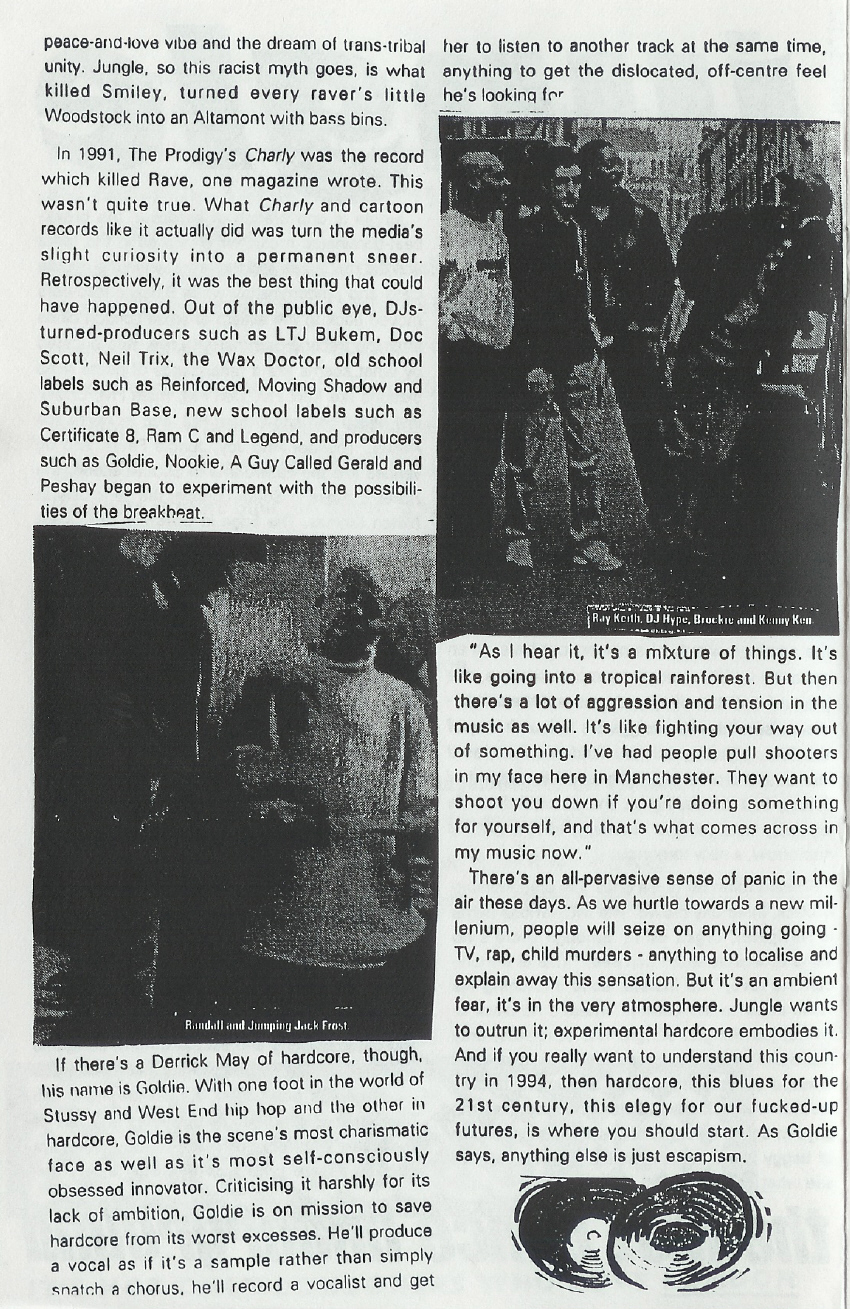
In 1991, The Prodigy's Charly was the record which killed Rave, one magazine wrote. This wasn't quite true. What Charly and cartoon records like it actually did was turn the media's slight curiosity into a permanent sneer. Retrospectively, it was the best thing that could have happened. Out of the public eye, DJs-turned-producers such as LTJ Bukem, Doc Scott, Neil Trix, the Wax Doctor, old school labels such as Reinforced, Moving Shadow and Suburban Base, new school labels such as Certificate 8, Ram C and Legend, and producers such as Goldie, Nookie, A Guy Called Gerald and Peshay began to experiment with the possibilities of the breakbeat.
Randall and Jumping Jack Frost
If there's a Derrick May of hardcore, though, his name is Goldie. With one foot in the world of Stussy and West End hip hop and the other in hardcore, Goldie is the scene's most charismatic face as well as it's most self-consciously obsessed innovator. Criticising it harshly for its lack of ambition, Goldie is on mission to save hardcore from its worst excesses. He'll produce a vocal as if it's a sample rather than simply snatch a chorus, he'll record a vocalist and get
her to listen to another track at the same time, anything to get the dislocated, off-centre feel he's looking for
Ray Keith, DJ Hype, Brockie and Kenny Ken
"As I hear it, it's a mixture of things. It's like going into a tropical rainforest. But then there's a lot of aggression and tension in the music as well. It's like fighting your way out of something. I've had people pull shooters in my face here in Manchester. They want to shoot you down if you're doing something for yourself, and that's what comes across in my music now."
There's an all-pervasive sense of panic in the air these days. As we hurtle towards a new millenium, people will seize on anything going - TV, rap, child murders - anything to localise and explain away this sensation. But it's an ambient fear, it's in the very atmosphere. Jungle wants to outrun it; experimental hardcore embodies it. And if you really want to understand this country in 1994, then hardcore, this blues for the 21st century, this elegy for our fucked-up futures, is where you should start. As Goldie says, anything else is just escapism.
Page 5
Feature
"PaSS the INformation..."
Rollin' dem beats since the early '90's Grooverider, Hype, Randall, Slipmatt, Fabio, Dr. S. Gachet, and Jumpin' Jack Frost have taken the London hardcore sound through some incredible transformations. These pioneers have united ravers in warehouses, airplane hangers, and sweaty clubs alike. Their vision of rave music and how to move a crowd has kept them at the forefront of today's London rave circuit for well over four years.
In the early days of rave in London, groups like the Happy Mondays preached the hedonism of drug culture and youth. The kids began to gather, drop an "E" and go all night to the up and coming DJs listed above.
Working with techno and garage, or house, tunes, these DJs began to inch up the BPM and kick it faster. Soon the house divas were sounding like chipmunks as the DJs responded to an interest in more speed.
By 1992 kids were dancing to parties thrown by large scale promoters like Raindance, Orange, Universe, and Dance '92. Breakbeat became more common with most rave DJs blending a bouncy, uplifting piano, happy chipmunk vocals, and a wicked sub bass at about 140 BPM. The kids went crazy with many raves drawing upward of 5000 people.
As 1993 approached, the DJs took the music deeper. As the drug culture of raving in London fueled a more intense "mix and blend" DJs like Hype, Randall, and Gachet moved the music to the darkside. Those uplifting vocal passages and piano breaks were replaced by a more eerie underground sound reflecting a deeper and darker side of the rave culture...A culture whose love of the music was reflected in 160BPM and more separation of sounds creating a more intense rave experience.
Page 6
Feature
It was in late '92 early '93 that DJ's began experimenting with reggae samples to accompany the breakbeat. These early pioneers were once again pushing London hardcore to its present and exciting form...Jungle early selectors like Jumpin Jack Frost were just hinting at the popularity and potential for this form of hardcore, a mix of breakbeat, reggae, and live MC 'toasting' in a raggamuffin or dance hall style.
By Mid 1993, kids in the U.K. could not get enough of it--creating literal road blocks on routes into towns were large rave events were being staged. Events such as "World Dance", a 12 hour marathon held in an airplane hangar, were drawing people from all over the U.K.
It was also around this time that promoters began the event called "Jungle Fever". Linking the ruffest jungle selectors for 16 hour sessions of 160+BPM breakbeat, ragga, and live MC that would work the crowd into a frenzy. The most recent "Jungle Fever" drew over 4000 inside and 2000 outside unable to get in. When the radio pirates at Kool-FM say "believe me...it's gonna be a road block" you can be sure they know the cue.
Meanwhile, on the other side of the pond, a group of Chicago selectors began to hone their skill in a London style. While rave sputtered in Chicago, revving up only to flounder due to infighting and lack of cohesion among promoters, the Milwaukee scene took control. The highly organized and professional efforts of Milwaukee's largest rave promoter developed a reputation for "delivering the goods" and the kids flocked to the events. These promoters are respected for their line up of gabber DJs and production on the main stage. Understandably, for the last two years
DANCE! DANCE! DANCE!
Page 7
Feature
they have stuck with what has worked for them...The group of DJs collectively known as "The Chicago Hardcore Authority Soundsystem" has played in side rooms on inadequate systems, kicking the most wicked up-front jungle for not much more than 50 devoted fans. Ironically, the jungle sound that draws 50 people in Chicago can draw over 5000 insane ravers in London.
To our north, just nine hours away, Toronto, Ontario, Canada has developed a rave scene that is unequaled in North America. A committed group of organized and professional promoters throw large scale events drawing upward of 3000 people. Delirium, Pleasure Force, Syrous, and Atlantis guarantee a workout with up-front jungle and hard trance selectors. The popularity of jungle in Toronto is rivaled only by London itself. Regularly hosting DJs from the U.K., Toronto is
a model for what Chicago could be.
With "Destiny" the incredible work of Mushgroove, Vibe Alive, and Ripe, bring the finest sounds of Toronto, London, and C.H.A. sound system to the mainstage.
"So listen up all a' you Junglists and hold tight!! It's time to take control, ohmigosh, let the beats roll!!!"
This is the future.
-by Scott and Kay
CHA Massive
Raves
Björk
Milton Nascimento He's brilliant. Odd chords, so it brings a bit of an edge. I listen to him when I'm in a shivery mood, kind of like you haven't got a skin on. And it makes me happy.
Pirate jungle radio stations I pick them up in London. If I say what jungle music's like, it makes it so banal. It's an attitude, very happy and organic, while hard-core techno is banging your head against a wall.
Page 8
Interview
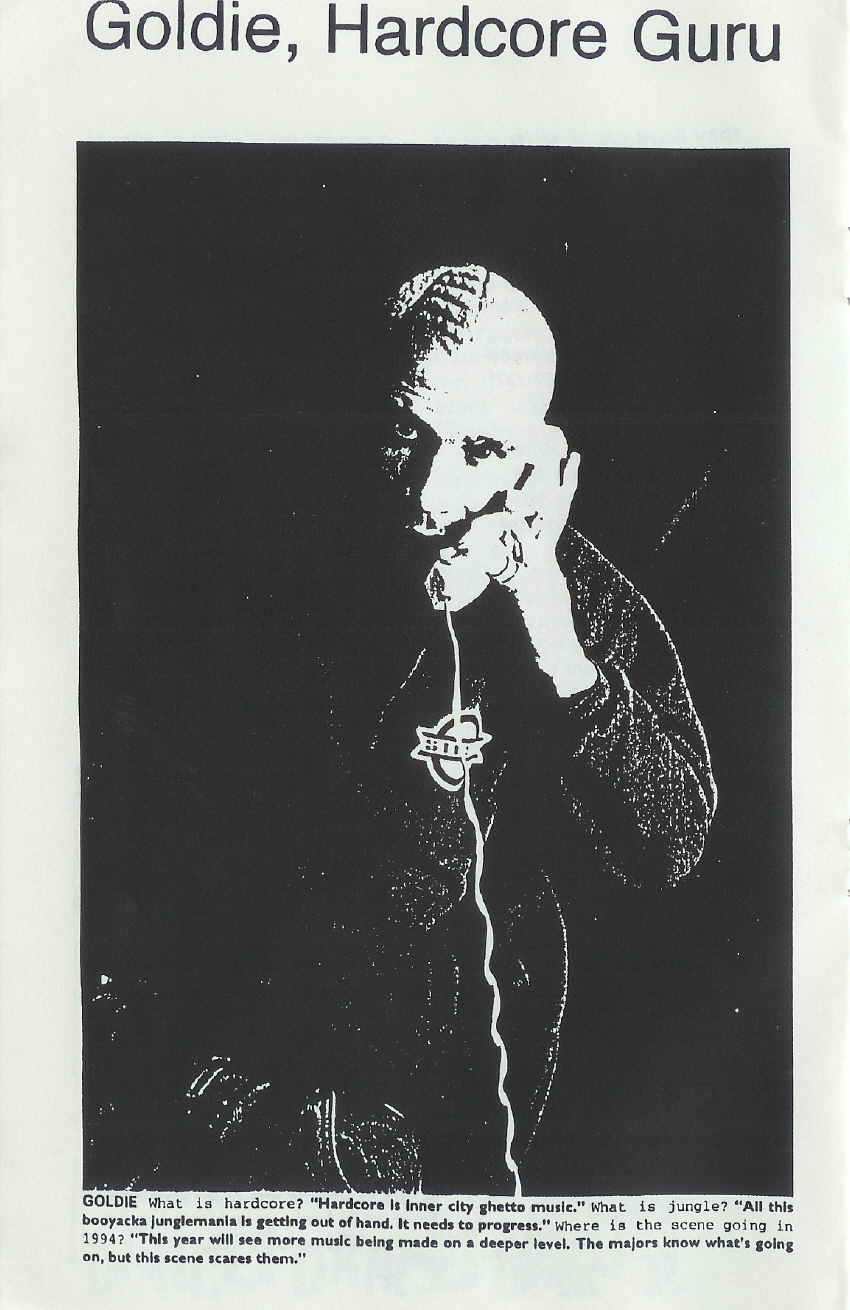
Goldie, Hardcore Guru
GOLDIE What is hardcore? "Hardcore is inner city ghetto music." What is jungle? "All this booyacka junglemania is getting out of hand. It needs to progress." Where is the scene going in 1994? "This year will see more music being made on a deeper level. The majors know what's going on, but this scene scares them."
Page 9
Feature
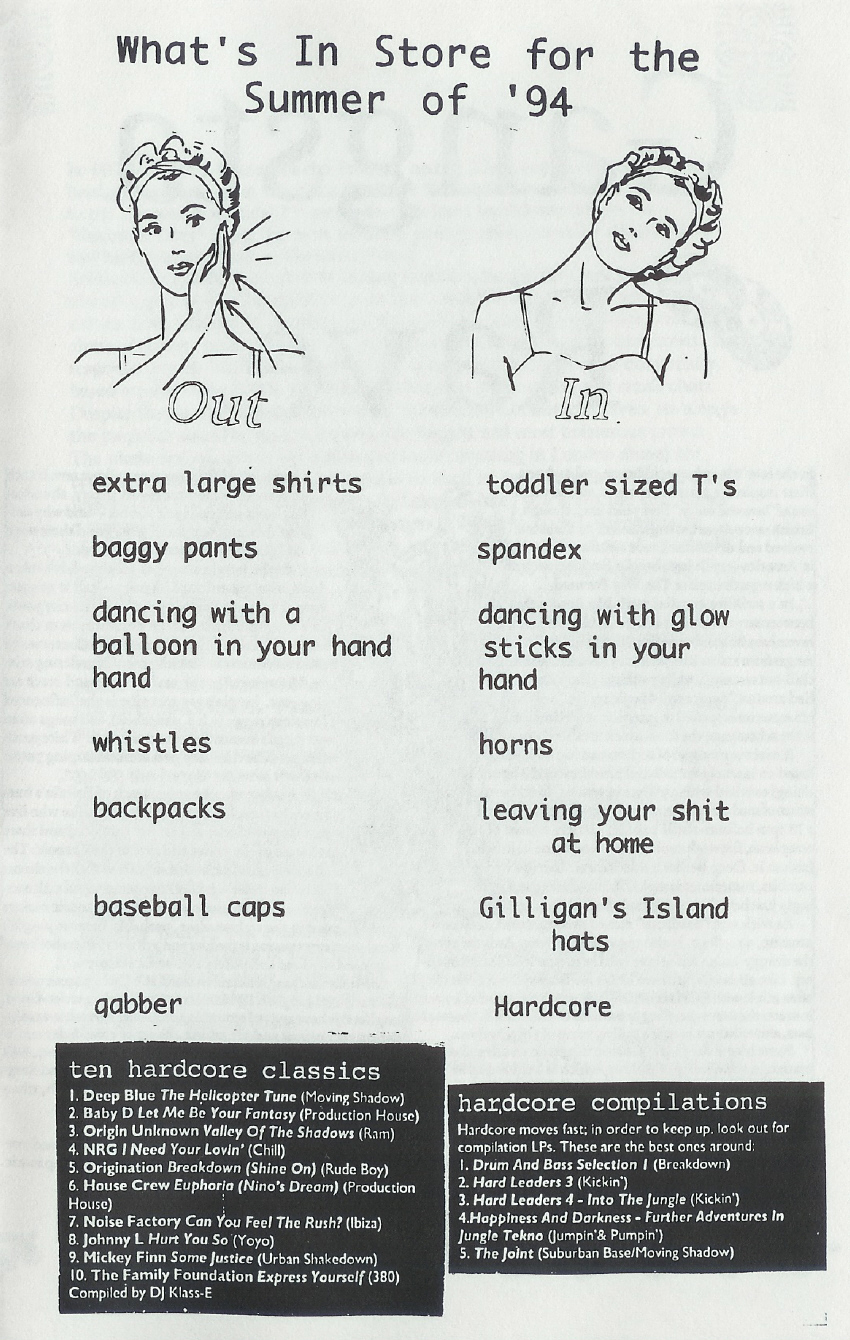
What's In Store for the Summer of '94
Out
extra large shirts
baggy pants
dancing with a balloon in your hand hand
whistles
backpacks
baseball caps
gabber
In
toddler sized T's
spandex
dancing with glow sticks in your hand
horns
leaving your shit at home
Gilligan's Island hats
Hardcore
ten hardcore classics
1. Deep Blue The Helicopter Tune (Moving Shadow)
2. Baby D Let Me Be Your Fantasy (Production House)
3. Origin Unknown Valley Of The Shadows (Ram)
4. NRG I Need Your Lovin' (Chill)
5. Origination Breakdown (Shine On) (Rude Boy)
6. House Crew Euphoria (Nino's Dream) (Production House)
7. Noise Factory Can You Feel The Rush? (Ibiza)
8. Johnny L Hurt You So (Yoyo)
9. Mickey Finn Some Justice (Urban Shakedown)
10. The Family Foundation Express Yourself (380)
Compiled by DJ Klass-E
hardcore compilations
Hardcore moves fast; in order to keep up, look out for compilation LPs. These are the best ones around:
1. Drum And Bass Selection 1 (Breakdown)
2. Hard Leaders 3 (Kickin')
3. Hard Leaders 4 - Into The Jungle (Kickin')
4. Happiness And Darkness - Further Adventures In Jungle Tekno (Jumpin'& Pumpin')
5. The Joint (Suburban Base/Moving Shadow)
Page 10
Feature
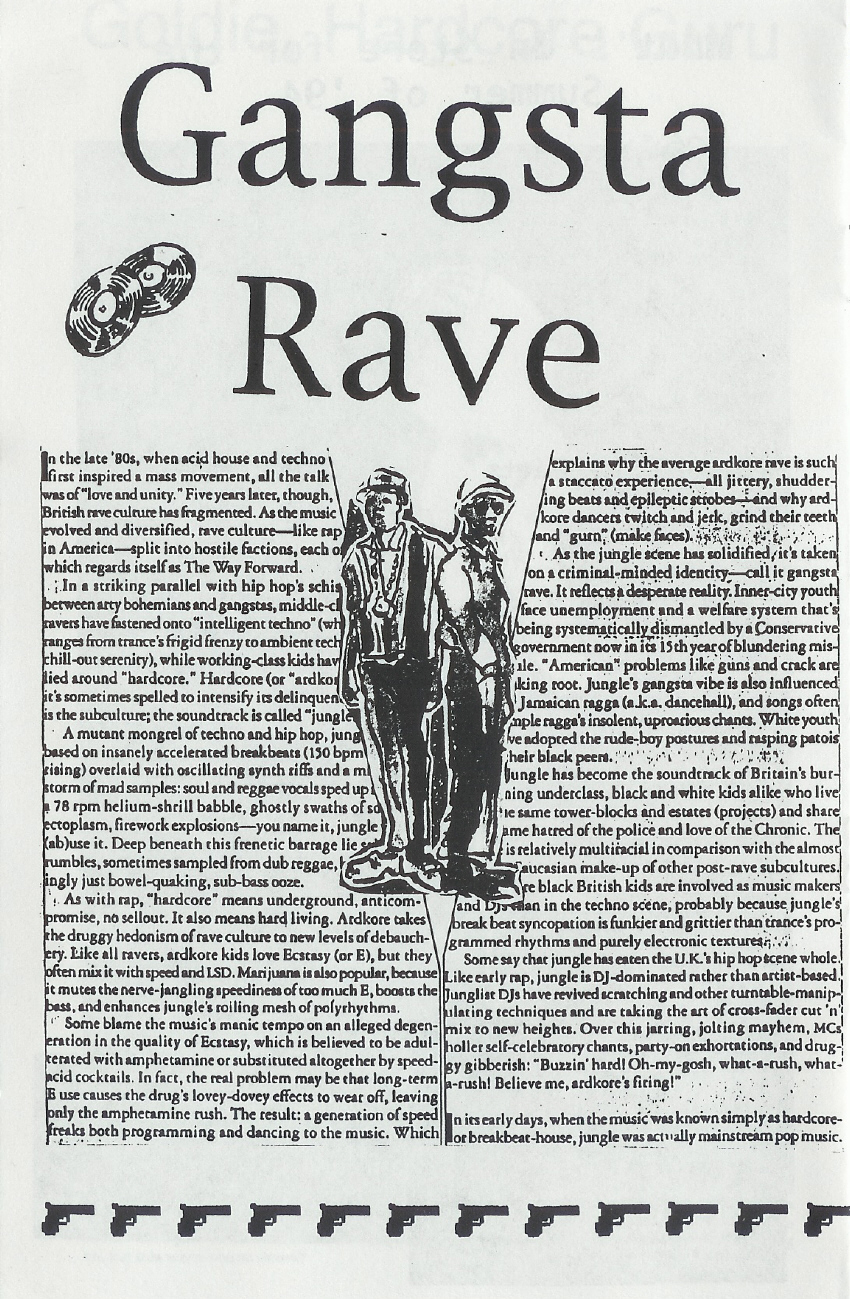
Gangsta Rave
In the late '80s, when acid house and techno first inspired a mass movement, all the talk was of "love and unity." Five years later, though, British rave culture has fragmented. As the music evolved and diversified, rave culture—like rap in America—split into hostile factions, each of which regards itself as The Way Forward.
In a striking parallel with hip hop's schism between arty bohemians and gangstas, middle-class ravers have fastened onto "intelligent techno" (which ranges from trance's frigid frenzy to ambient techno's chill-out serenity), while working-class kids have rallied around "hardcore." Hardcore (or "ardkore," as it's sometimes spelled to intensify its delinquency) is the subculture; the soundtrack is called "jungle."
A mutant mongrel of techno and hip hop, jungle is based on insanely accelerated breakbeats (150 bpm and rising) overlaid with oscillating synth riffs and a maelstrom of mad samples: soul and reggae vocals sped up to a 78 rpm helium-shrill babble, ghostly swaths of sonic ectoplasm, firework explosions—you name it, jungle will (ab)use it. Deep beneath this frenetic barrage lie sub-bass rumbles, sometimes sampled from dub reggae, but mostly just bowel-quaking, sub-bass ooze.
As with rap, "hardcore" means underground, anticompromise, no sellout. It also means hard living. Ardkore takes the druggy hedonism of rave culture to new levels of debauchery. Like all ravers, ardkore kids love Ecstasy (or E), but they often mix it with speed and LSD. Marijuana is also popular, because it mutes the nerve-jangling speediness of too much E, boosts the bass, and enhances jungle's roiling mesh of polyrhythms.
Some blame the music's manic tempo on an alleged degeneration in the quality of Ecstasy, which is believed to be adulterated with amphetamine or substituted altogether by speed-acid cocktails. In fact, the real problem may be that long-term E use causes the drug's lovey-dovey effects to wear off, leaving only the amphetamine rush. The result: a generation of speed freaks both programming and dancing to the music. Which explains why the average ardkore rave is such a staccato experience—all jittery, shuddering beats and epileptic strobes—and why ardkore dancers twitch and jerk, grind their teeth and "gurn" (make faces).
As the jungle scene has solidified, it's taken on a criminal-minded identity—call it gangsta rave. It reflects a desperate reality. Inner-city youth face unemployment and a welfare system that's being systematically dismantled by a Conservative government now in its 15th year of blundering misrule. "American" problems like guns and crack are taking root. Jungle's gangsta vibe is also influenced by Jamaican ragga (a.k.a. dancehall), and songs often sample ragga's insolent, uproarious chants. White youth have adopted the rude-boy postures and rasping patois of their black peers.
Jungle has become the soundtrack of Britain's burgeoning underclass, black and white kids alike who live in the same tower-blocks and estates (projects) and share the same hatred of the police and love of the Chronic. The scene is relatively multiracial in comparison with the almost all-Caucasian make-up of other post-rave subcultures. More black British kids are involved as music makers and DJs than in the techno scene, probably because jungle's breakbeat syncopation is funkier and grittier than trance's programmed rhythms and purely electronic textures.
Some say that jungle has eaten the U.K.'s hip hop scene whole. Like early rap, jungle is DJ-dominated rather than artist-based. Junglist DJs have revived scratching and other turntable-manipulating techniques and are taking the art of cross-fader cut 'n' mix to new heights. Over this jarring, jolting mayhem, MCs holler self-celebratory chants, party-on exhortations, and druggy gibberish: "Buzzin' hard! Oh-my-gosh, what-a-rush, what-a-rush! Believe me, ardkore's firing!"
In its early days, when the music was known simply as hardcore or breakbeat-house, jungle was actually mainstream pop music.
Page 11
Feature
In 1991 and 1992 bands like the Prodigy, and SL2 had Top Five hits with their hardcore anthems. But when the Prodigy's "Charly" inspired a rash of imitators to put samples from kids' TV programs over lame breakbeats (Smart E's "Sesame's Treet" being the most famous), pundits proclaimed the death of rave, and hardcore went back to the underground.
Strongest in London and its surrounding counties, the jungle scene acquired something of a siege mentality/persecution complex: it's a ghetto within rave culture now, scorned by hipsters and tastemakers. Some "progressive" techno clubs advertise "no breakbeats" on the grounds that jungle draws a bad crowd. In response, jungle has bunkered down into a defiantly self-sufficient community, based around indie labels, specialty dance shops, pirate radio, and small clubs. Despite the media blackout however, at the massive commercial raves, its always the jungalist sound system that draws the biggest and most boisterous crowd.
The pirate stations (there are a dozen or more operating in London alone) are crucial, sustaining the subculture's sense of itself as subterranean--a shared secret underworld. The MC's cryptic slang and slogans like "you know the key" create a conspiratorial air. Kids page in messages, sometimes coded, suggestive of clandesitne, nefarious deals, but mostly just salutations--"big shouts" and "nuff respects" sent out to other "massives" (any gathering of youths bigger than two) huddled around the radio, rolling spliffs and getting red-eye.
For all its futuristic sound, though, jungle is firmly in keeping with the British working class 'weekender' tradition, sharing a love of pill popping and up tempo beats. Hardcore has been compared to Oi! a lumpen-and-proud-of-it offshoot of punk. But what distinguishes jungle from its ancestors is the sheer desperation that fuels its hedonism. Facing the same "No Future" that goaded mid-70's punks into revolt, junglist youth live for now--a present that becomes ever more accentuated and circumscribed as the recession bites harder.
In 93, the jungle sound shifted decisively from "happy hardcore" (rapturous babytalk vocals and piano riffs) toward dark tunes. The dark style consists of stark drum and bass minimalism overlaid with horror-show movie noises and soundbites that hint at the underside of fast living.
Dark side tunes probably have everything to do with one effect of extended E usage, paranoia. But in another sense, "dark" simply is a development of jungle's gangsta vibe: aligning yourself with the dark side is one way of pro-claiming yourself one baaad muthafucka.
One of the trailblazers of dark jungle is Goldie, a young black Briton. Goldie is trying to push the genre forward with sample-modulation techniques like time-stretching and tracks like "Angel" which layers jazzy female vocals and lush texture over rolling beats.
And he's not alone. Goldie is just one part of a progressive vanguard in jungle that includes artists such as Foul Play, 2 Bad Mice, and DJ Hype, and labels such as Moving Shadow, Suburban Base, and Reinforced. Goldie crystalizes the new jungle vibe when describing the sound clash of langorous, Eno-esque atmosphere with dangerous beats. "I wish I could live the ambient dream," he says, "but I have to face reality."